From the Edges — Creative Practices of Cosmaking: How cosplayers experience costume creation in Aotearoa New Zealand and Australia – By Cathryn Pudner
In our ‘From The Edges’ series we feature Aotearoa NZ Academic Design Projects. Our practice as designers can be seen to be explored, pushed and perhaps become something entirely new where it exists at the edges of our practice in the world of academia. Free from the constraints of commercial outcomes and clients, designers explore and challenge existing paradigms.
In this article, we talk with Cathryn Pudner about Creative Practices of Cosmaking: How cosplayers experience costume creation in Aotearoa New Zealand and Australia, a Master of User Experience Design project from Te Herenga Waka Victoria University of Wellington exploring cosplay as a creative practice shaped by design, community, and collaboration.
What’s your background?
I originally studied to be an anthropologist. I graduated with a BA and BA (Hons) from the University of Auckland where I specialised in biological and medical anthropology. I’ve always been fascinated by humans. But more importantly, I wanted to contribute to positive societal change. I started working in non-profits doing research, marketing, and (in retrospect) design work.
After a while, I started to feel a bit lost about my career’s direction and impact. I had what seemed like a disjointed range of skills – I was deeply interested in people, culture, contexts, and I really liked creating things. I moved to Australia and picked up a role that, due to COVID-19, serendipitously morphed into a product design role. That’s when I looked into UX/UI and learned about human-centred design. I realised that this was exactly the kind of work I’d been looking for.
After working as a designer for a few years, I enrolled in a Master of User Experience Design to bridge my existing and emerging skills and test my foundations. Since then, I’ve worked on strategic, service, and product design projects across the Australian government, insurance, healthcare, and education sectors.
Who is your favourite designer/creative/artist and why?
Honestly, I can never choose just one… But for this question, I’ll say: Lauren Marx. She creates beautifully macabre watercolour and ink illustrations of nature, animals, death, and decay. I find her work very intricate and layered, and yet full of life despite the subject matter.
What goals and aspirations do you have for the future?
I’d love to become a travelling designer, artist, and anthropologist of sorts 👩🏻🎨 I’m mostly interested in floating between Aotearoa, Australia, Japan, and Thailand, where perhaps I could run my own design practice. I enjoy moving between big strategic design work and more intimate, community-level projects. Lately, I’m more drawn to local creative practices, cultural rituals, and the folklore and belief systems that shape them. I want to explore these spaces more through my career – or, perhaps, through academia… I think I’d love to do a PhD in design and anthropology one day.
When did you first learn about your area of specialty? What about it piqued your interest?
As a kid, I was always drawn to art and visual design but I wasn’t certain about the career prospects. When I moved into a product design role around 2020, it felt like a second chance to pursue graphic and web design. That’s when I discovered UX/UI and, more specifically, human-centred design (HCD). I realised how much of the design process is actually informed by research – which was something I sensed was missing in my role, but didn’t yet have the language or framework to explore. The research component changed how I understood UX/UI and design. I realised that it wasn’t just about the pixels on a screen but more about the broader intention and ongoing use of the design within a specific system.
What really piqued my interest was how much of HCD aligns with anthropology. Methods like ethnographic observation and affinity mapping were already familiar to me, and I realised that design was like an applied anthropology. It wasn’t just about aesthetics – it was also about understanding the behavioural and cultural context. This was the lens I already knew how to use, so it was a bit of a “full circle” moment for me.
What’s the background of your current project?
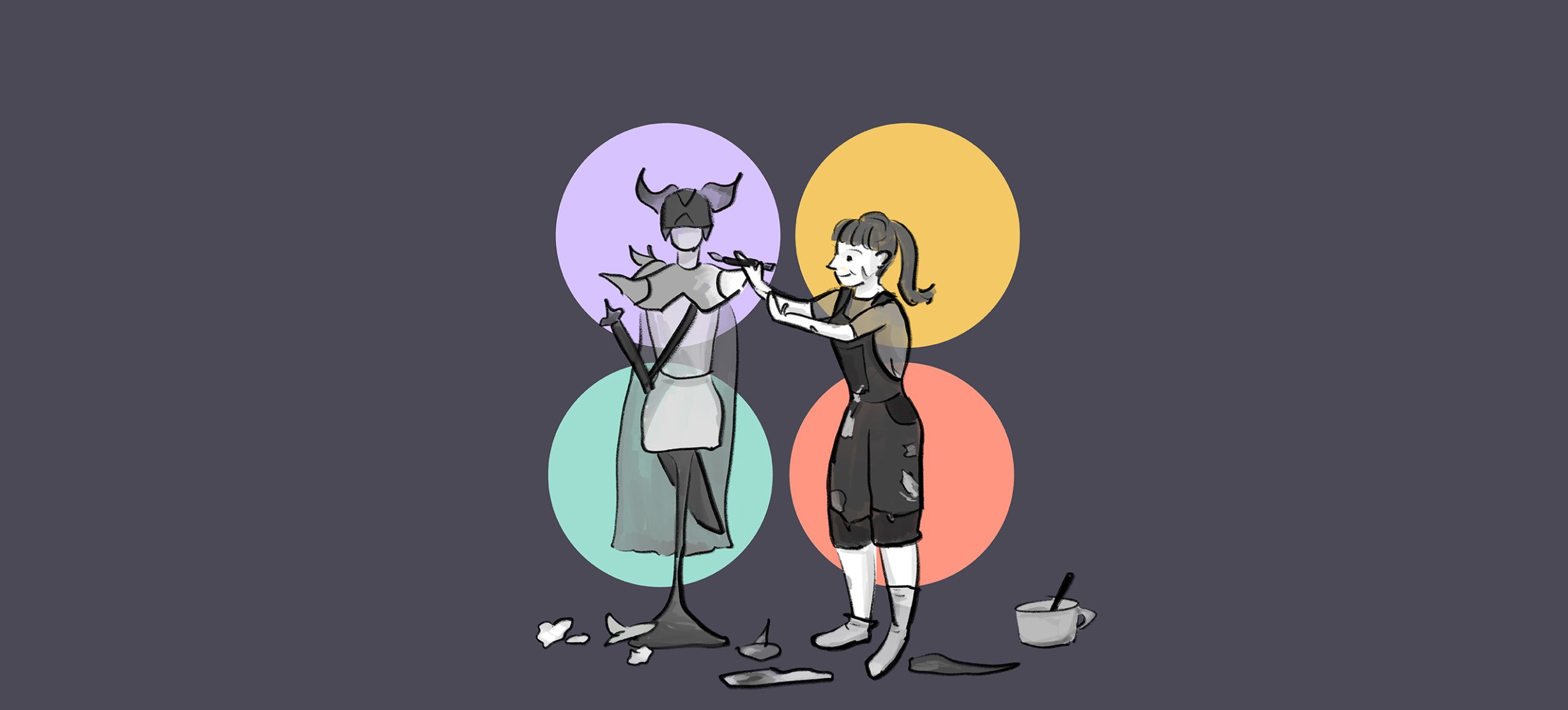
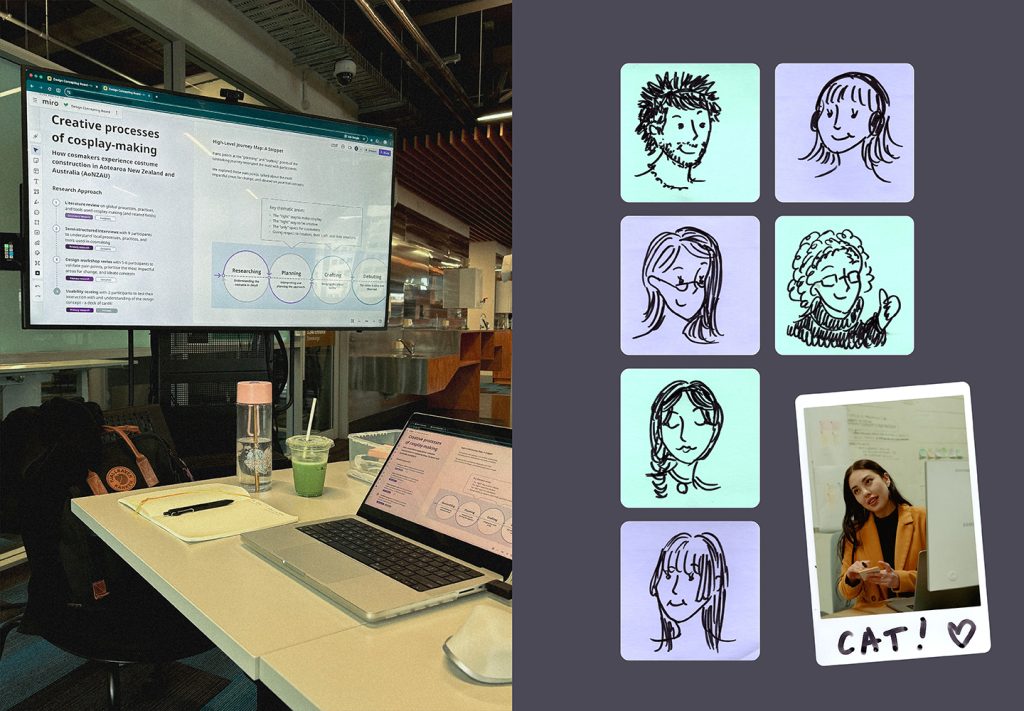
I took the research pathway for my Master of UX Design. As of 2025, it’s a new pathway where students can propose their own research topic and shape their own activities. My Masters explores the creative practices of making cosplay (cosmaking) in Aotearoa and Australia, with the idea that I might be able to design something that could help cosmakers when they make costumes.
I interviewed cosmakers across Aotearoa and Australia to understand their individual processes, behaviours, values, constraints, and concerns. Those conversations informed the creation of a cosmaking journey map. It was very challenging to capture all the variable steps and elements of cosmaking into a single visual artefact. Cosmaking is wildly expansive. I created a giant map that included all my research data, but I also distilled my key insights into a “high-level” map specifically for sharing with my participants. The high-level map was used in my design workshops. This was where I sat down with a small group of cosmakers to evaluate my insights and explore the community’s collective challenges more deeply.
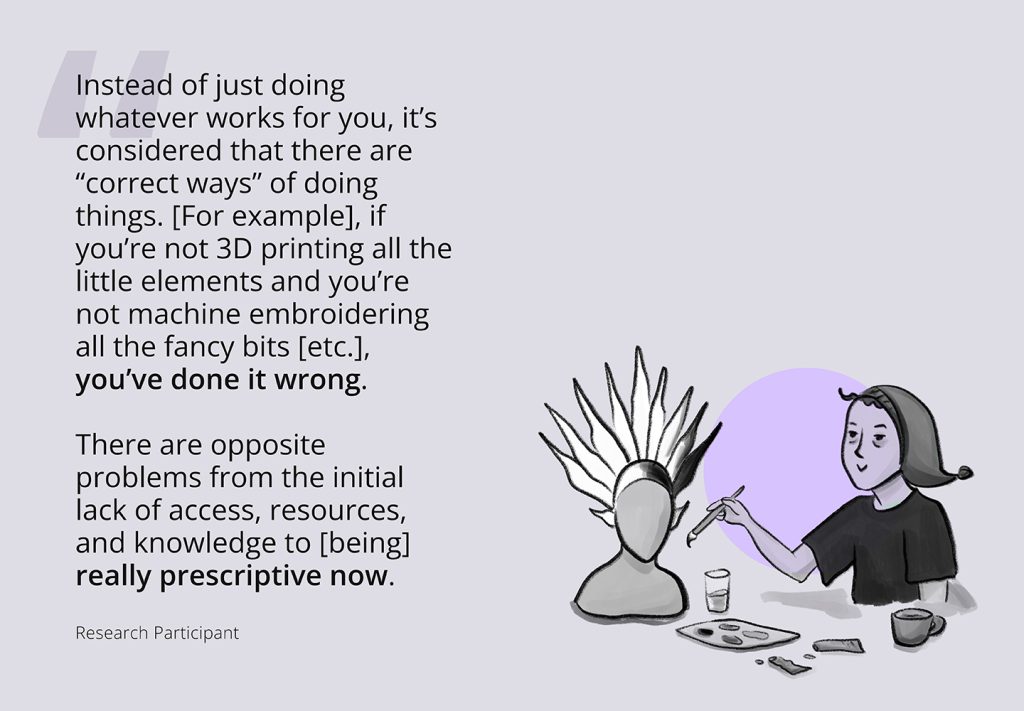
Originally, it seemed that access to cosplay opportunities, tools, knowledge, and resources, was one of the most pressing issues for cosmakers. This makes a lot of sense for cosmakers in Aotearoa and Australia. After all, we’re already quite far from the most prominent cosplay stages and communities. But after my design workshops, I was able to surface a more nuanced problem – a problem around creativity itself. My primary research insights revealed a dynamic between how fandom and cultural capital get measured: the friction between perceived skill and accuracy; how knowledge is either secret and protected or highly accessible and overwhelming; and how cosmaking techniques can become a scale of progression rather than a spectrum of creativity. In short, there was tension around the “right” way to be creative and to make cosplay.
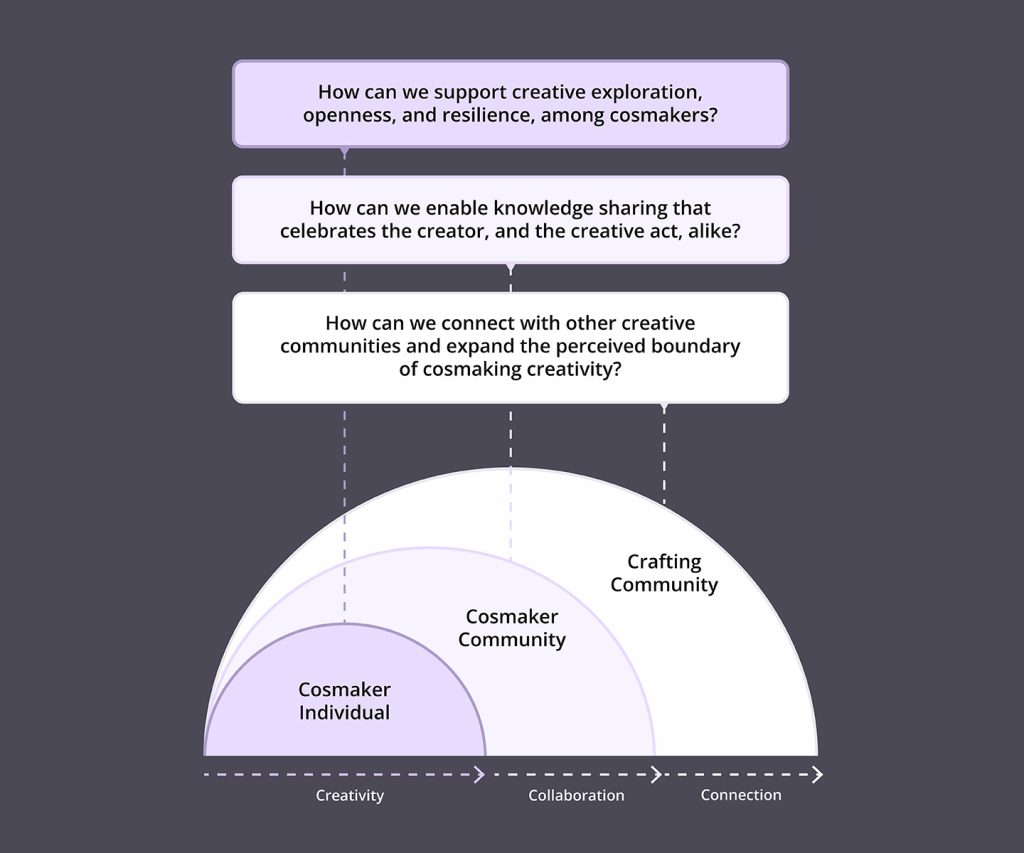
That tension, between creative liberty and obligation, helped me reconsider how I might approach my design concept. I felt that my solution couldn’t just support cosmaking as a process. Instead, it needed to support cosmaking as a creative practice. That meant designing for mindsets and community as much as techniques and information sharing.
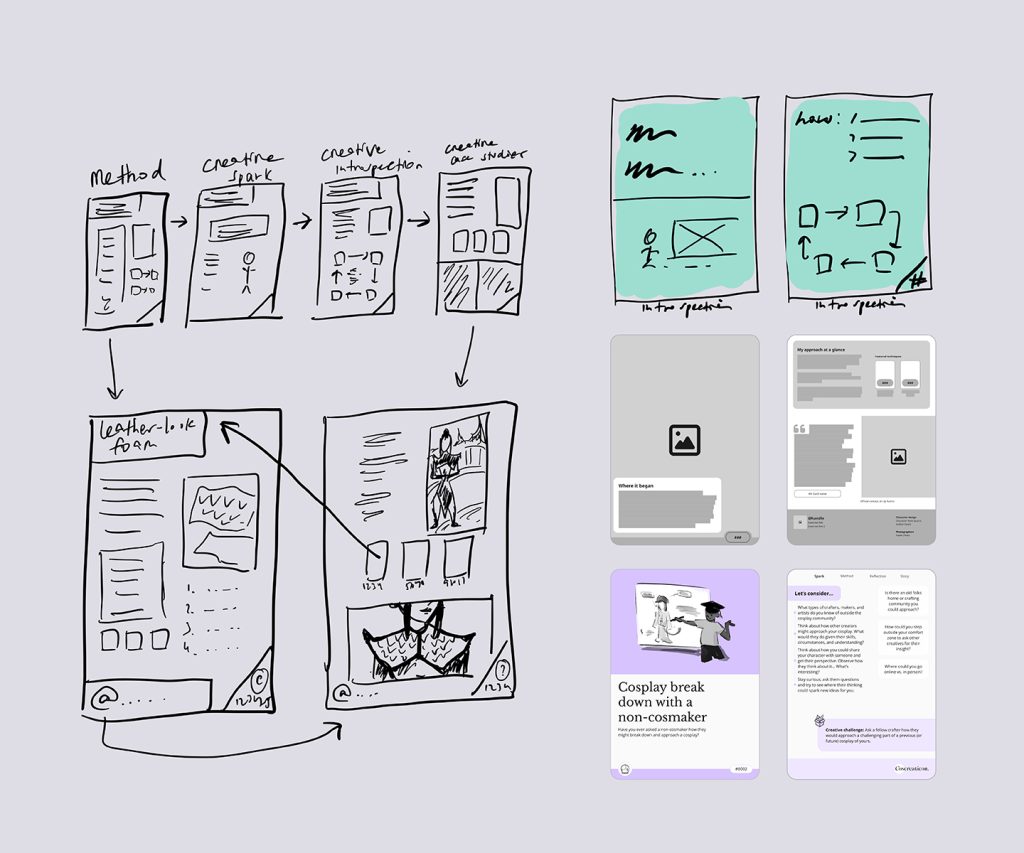
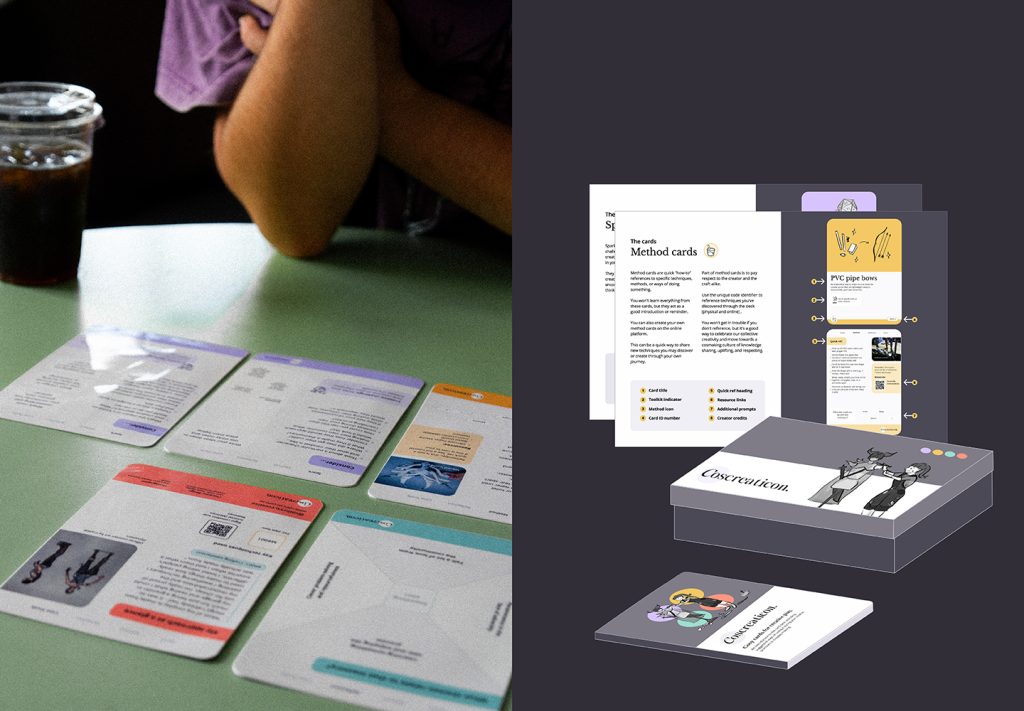
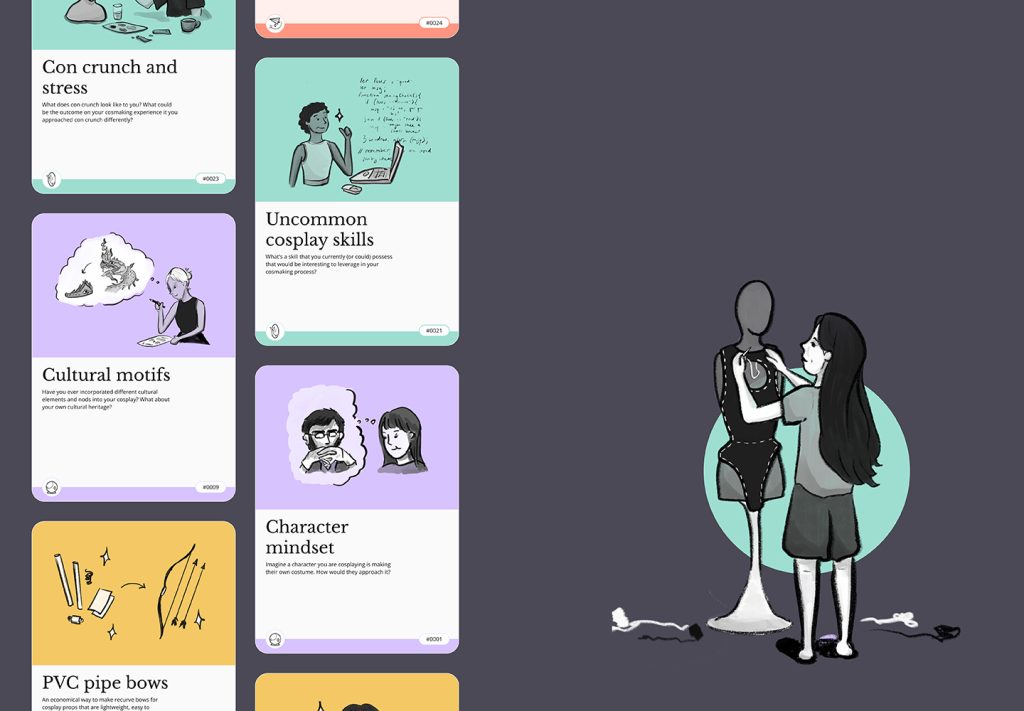
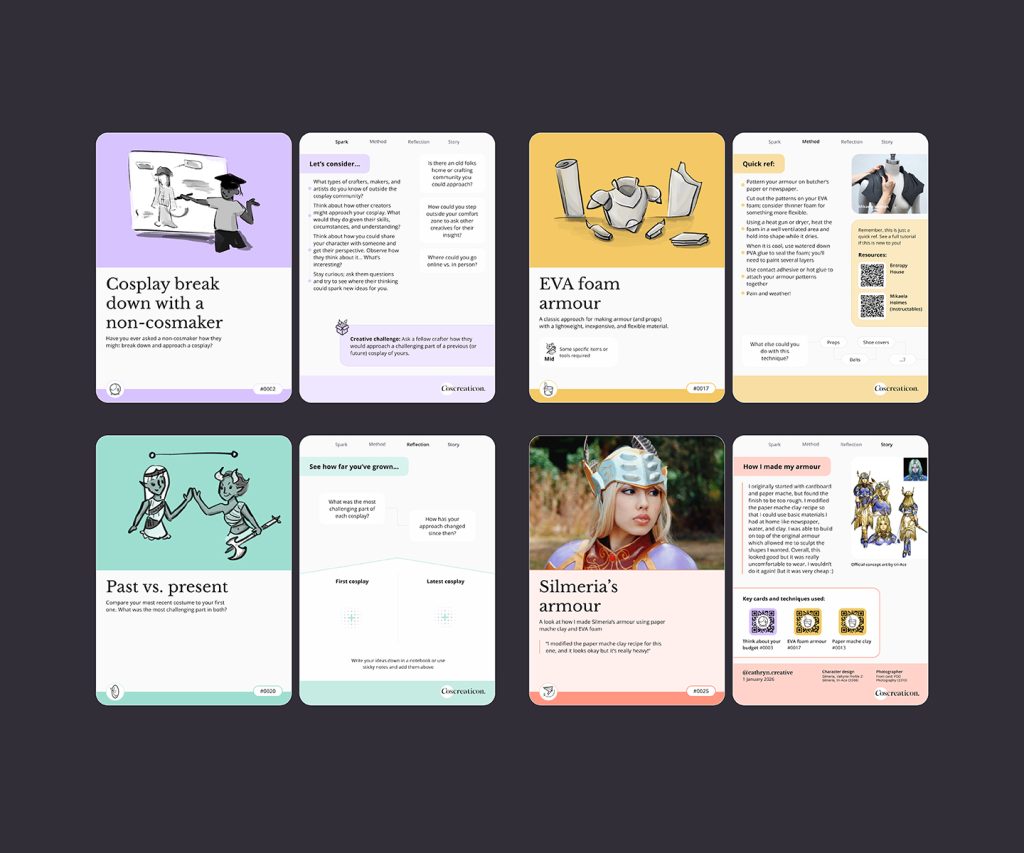
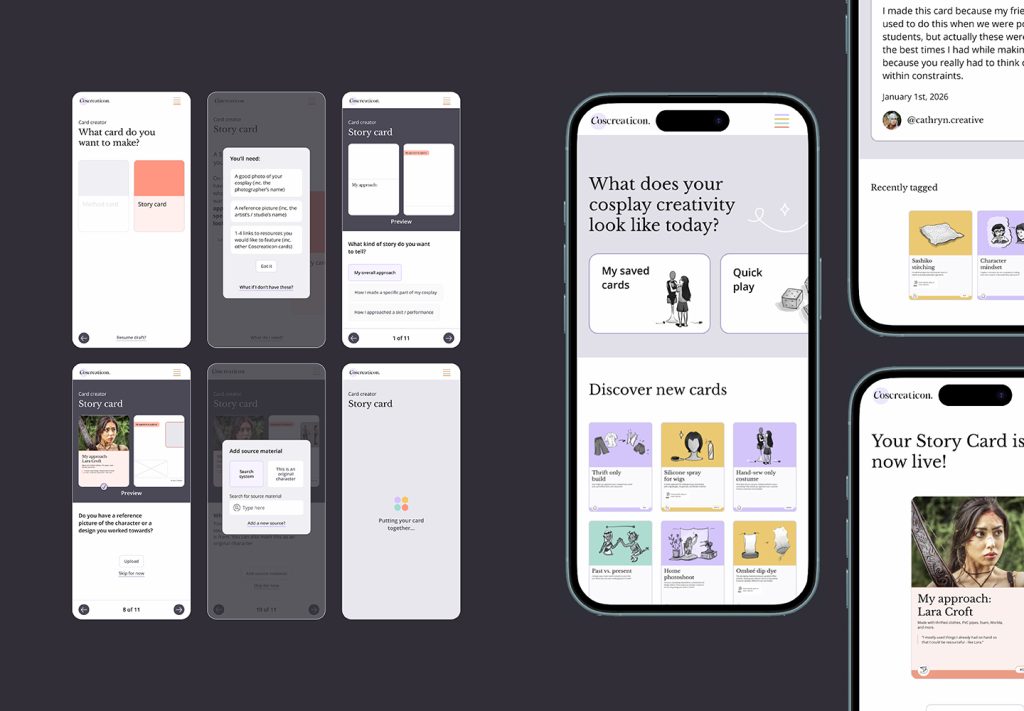
I designed a concept, Coscreaticon, which is a tool and a game. It’s a deck of cards that offers cosmakers different ways to nurture creativity, encourage more collaborative approaches to knowledge sharing, and invite conversations around the community’s place within a broader crafting ecosystem. The concept is also accompanied by a digital platform that cosmakers can use to create their own cards. Creativity is expansive and ever-growing. That means that the cards ought to evolve alongside the community. While the digital platform was designed as a secondary concept, the cards (my primary concept) were tested with a small group of cosmakers. The insights I gathered from usability testing helped me refine their design and shape aspects of the digital platform.
What were the catalysts/inspirations for undertaking post-grad and this particular project?
I did a lot of cosplay growing up! While I haven’t made anything for several years, I still have many connections to that space. Even though I’m not as active anymore, it’s not too far from my mind. I’ll be on the bus and think to myself, “How would I make so-and-so’s outfit?”, and I mentally plan it through from start (gathering materials) to finish (photoshoot).
Since moving into design, I realised that design process is everywhere – including cosplay. I was curious about how other cosmakers approached their process, and where it was similar or different from mine. And, since I use tools all the time in my design work, I was also curious about what a cosmaking support tool could look like.
Through your post-grad research have you made any interesting or unexpected discoveries or insights that you can share with us?
Based on my literature review and my own experiences with cosmaking, I remember thinking early on that my design concept would likely be digital. Cosplayers are at home online – the internet is where community happens before and after the convention. Even in my initial primary research, participants often framed design ideas through terms like “apps”, “forums”, and “social media”.
But as my problem reframed itself, my core research panel started to gravitate towards physical concepts too. The tactile experience is important to cosmakers – not just for the hobby itself, but for how identity and connections are forged. I ended up designing something that was physical first, and digital second. For a community that spans online and real-world landscapes, this felt right.
One of the most interesting discoveries happened during usability testing. After testing comprehension and navigation of the card prototypes, I invited participants to try out a gameplay mode (with me!). Seeing how people played with the cards, caught themselves in deep thought, and used them as a jumping-off point for more creative ideation was really cool. The sessions ran over a little because participants were having so much fun. Getting a glimpse of the cards in action like that made me feel like the concept was serving its purpose.
What has been the most challenging part of your research thus far? How did you overcome it, or are you still working to resolve it?
Across this project, I did about five research and design activities with 20+ participants across two countries… All while working full-time. The most challenging part was managing that workload within the time limitations I had.
To overcome these challenges, I had to be very deliberate about my own ways of working. I set up systems and processes right from the start, and front-loaded my research and write-up where I could. I built in excessive buffer time, evaluation check points, and pivot space so that I could plan for the unplannable as much as possible. After the experiences I had with my BA and BA (Hons), I really wanted to design a study approach that was realistic and sustainable – and also a little indulgent 🙂
In short, I treated my Masters as a project to be designed and managed, not just experienced. After several years of working as a designer, I genuinely trust in the process. I think leaning into it for project management is what kept me on track.
How has post-grad study impacted your design practice?
Postgrad has helped me identify industry best practices, giving me a clearer benchmark to gauge my own skills and pinpoint areas where I can improve.
It’s also deepened my understanding of design methodology and the epistemological frameworks underpinning design sense-making. Knowing more about design through an academic lens has given me a greater appreciation of (and strengthened my argument for) a human-centred approach to design and design research.
Why did you choose this particular program/university/qualification?
When I initially searched for a design Masters programme, there were only a few universities across Aotearoa and Australia that offered both remote teaching and part-time options. Victoria University of Wellington was a strong contender – it was also the only one that offered a UX-specific Masters. After speaking with the programme director, Bert Aldridge, I felt the Master of UX Design was the most practical and hands-on of all the programmes I looked at. But it was also the culture of VUW that I liked most. There’s a warm and culturally aware vibe at VUW, and other NZ universities, that I had been missing!
Socials
cathrynpudner@gmail.com / cathryn.pudner@vuw.ac.nz
Website
LinkedIn
Instagram
Coscreation Website
Victoria University of Wellington