From the Edges — Play Nice, Connect Queerly: Bridging Queer Generations – By Marvie Segismundo
In our ‘From The Edges’ series we feature Aotearoa NZ Academic Design Projects. Our practice as designers can be seen to be explored, pushed and perhaps become something entirely new where it exists at the edges of our practice in the world of academia. Free from the constraints of commercial outcomes and clients, designers explore and challenge existing paradigms.
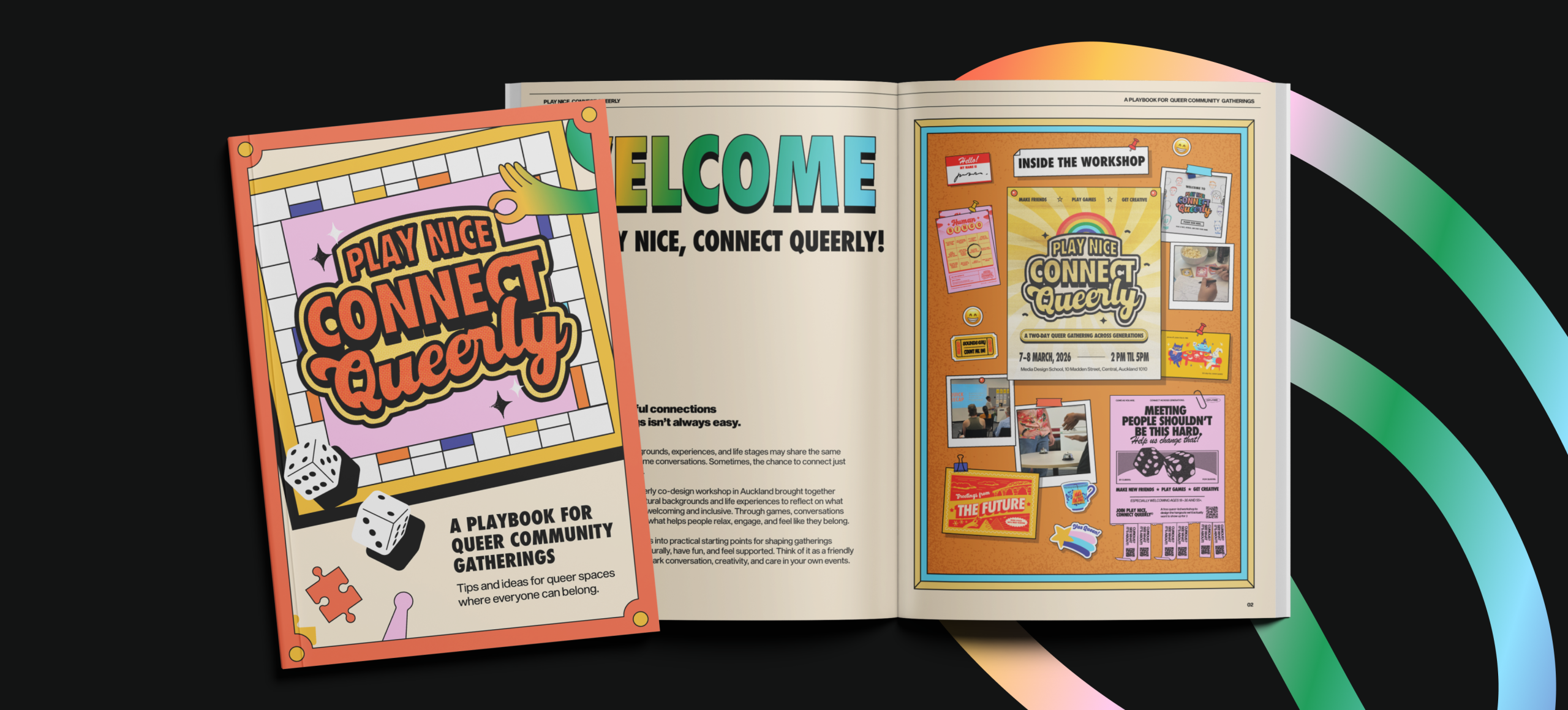
In this article, we talk with Marvie Segismundo about Play Nice, Connect Queerly: Bridging Queer Generations, a Master of Design project from Media Design School at Strayer exploring how play, storytelling, and shared experiences can foster connection across generations within the LGBTQIA+ community.
What’s your background?
I’m a queer designer born and raised in the Philippines. My journey into design wasn’t exactly straightforward. I studied Multimedia Arts at De La Salle-College of Saint Benilde, but when I first started, I knew very little about digital design. In fact, I failed my first major subject because I had no experience with the software or tools being taught. It was the first time I had ever failed a class, and while it was difficult at the time, it pushed me to work harder, stay curious, and embrace being a beginner. Looking back, it was probably one of the best things that could have happened to me.
Over the next 10 years, I built a career across branding, digital marketing, and design agencies, working with clients from a wide range of industries in the Philippines, Singapore, Australia, and the United States. Along the way, I learned as much from the people I worked with as I did from the work itself.
More recently, I moved to New Zealand to complete a Master of Design at Media Design School. The experience expanded my understanding of design beyond commercial outcomes and introduced me to more collaborative, community-focused ways of working, which continue to shape my practice today.
Who is your favourite designer/creative/artist and why?
My favourite artist is Keith Haring. I first came across his work while researching street art for my undergraduate thesis, and I’ve been drawn to his work ever since.
What draws me to Haring is not just his art, but what he stood for. During the AIDS epidemic, he used his visibility to advocate for communities that many people were turning a blind eye to. As someone from the rainbow community, that really resonates with me. I admire how he remained unapologetically himself and used his platform to stand up for others during a difficult time.
I also love how approachable his work is. His art is simple, playful, and instantly recognisable, but carries so much meaning. The fact that people from different backgrounds can connect with his work is something I find really special.
What goals and aspirations do you have for the future?
My goal is to continue building a career that allows me to stay curious, keep learning, and work on projects that genuinely matter to me. Over the years, I’ve realised that the projects I care about most are the ones centred around real people and real stories. While I enjoy the creative process itself, what matters most to me is knowing that the work has meaning beyond the screen.
What excites me most is the opportunity to keep learning from different people and perspectives. I enjoy projects that involve collaboration, storytelling, and creating experiences that bring ideas to life.
As I move forward in my career, I hope to keep learning from others, collaborating with different communities, and exploring how creativity can help people better understand one another and their experiences.
When did you first learn about your area of specialty? What about it piqued your interest?
I first became interested in branding and UI/UX during my undergraduate studies in Multimedia Arts. At the time, I was learning the fundamentals of design and became fascinated by how visuals, interactions, and experiences could influence the way people think and feel.
I’ve always been someone who likes observing things. Even outside of design, I find myself paying attention to why certain brands, websites, events, or experiences stick with people while others don’t. That’s what drew me to branding and UI/UX design. I love that something can be both beautiful and functional at the same time. The visuals might catch your attention, but it’s the overall experience that makes people remember it.
The longer I’ve worked in design, the more I’ve realised that what interests me most isn’t the output itself, but the people behind it. I love hearing people’s stories and understanding what motivates them, and that curiosity continues to shape the way I approach my work today.
What’s the background of your current project?
My project, Play Nice, Connect Queerly, began with a completely different question. Initially, I was interested in exploring what ageing looks like for child-free queer people. As a queer person myself, I was curious about what growing older without children might mean and how members of the LGBTQIA+ community navigate questions of care, support, and belonging later in life.
As I began interviewing people and conducting research, a different issue kept surfacing. Regardless of age, many participants spoke about social isolation, disconnection, and the challenges of building meaningful relationships. Through conversations with community members, researchers, and organisations such as Age Concern NZ and InsideOUT Kōaro, I discovered a strong desire for more intergenerational connection within the queer community. While there are organisations that support both younger and older LGBTQIA+ people, there are relatively few opportunities that intentionally bring these groups together. This disconnect risks losing valuable stories, lived experiences, and opportunities for care, mentorship, and the sharing of cultural knowledge.
This insight led me to reframe my project around a new design question: How might we create safe and meaningful intergenerational queer spaces that foster connection, care, and shared understanding?
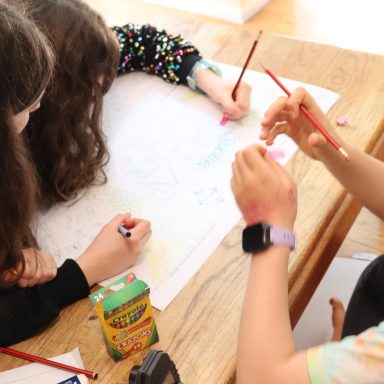
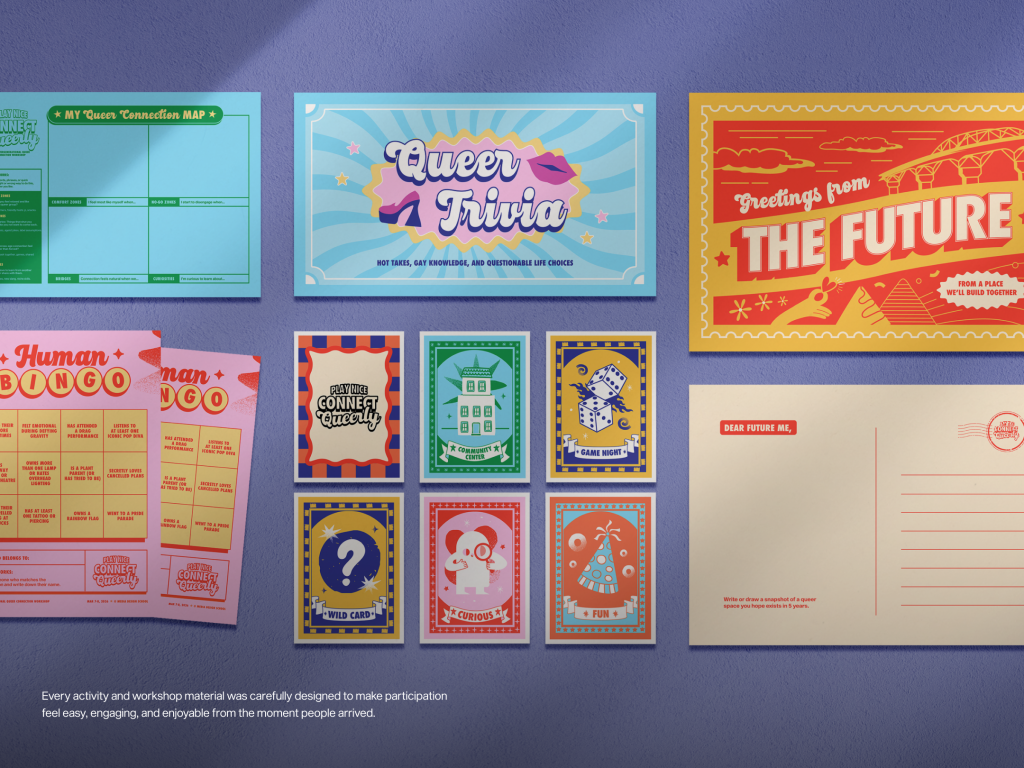
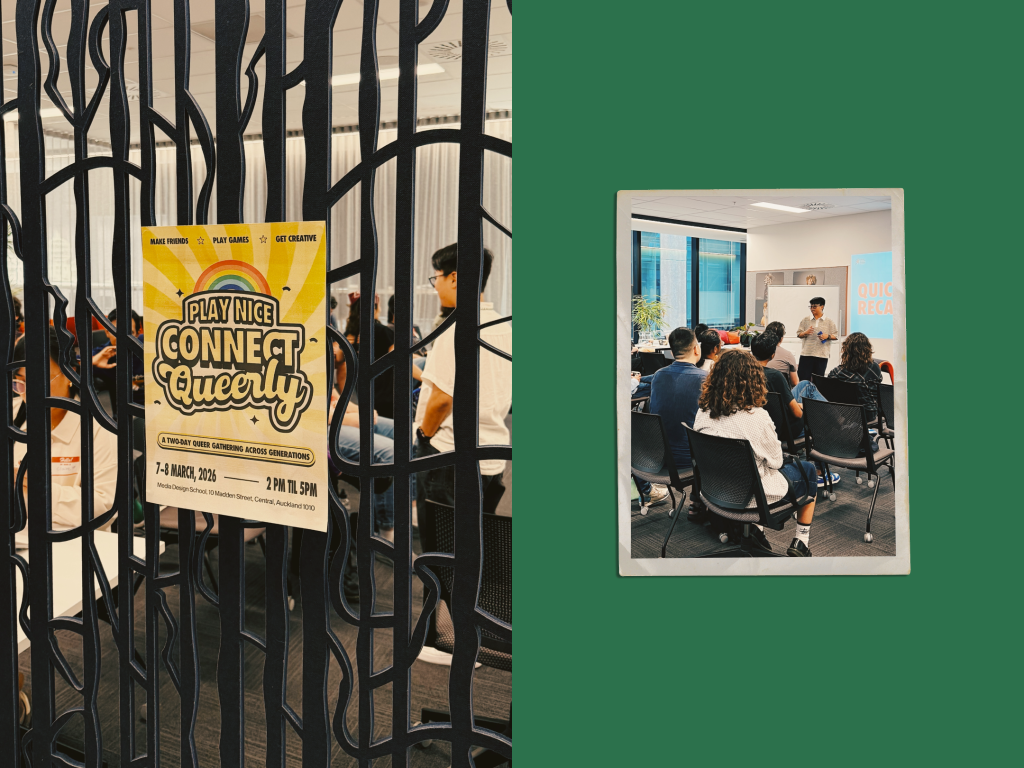
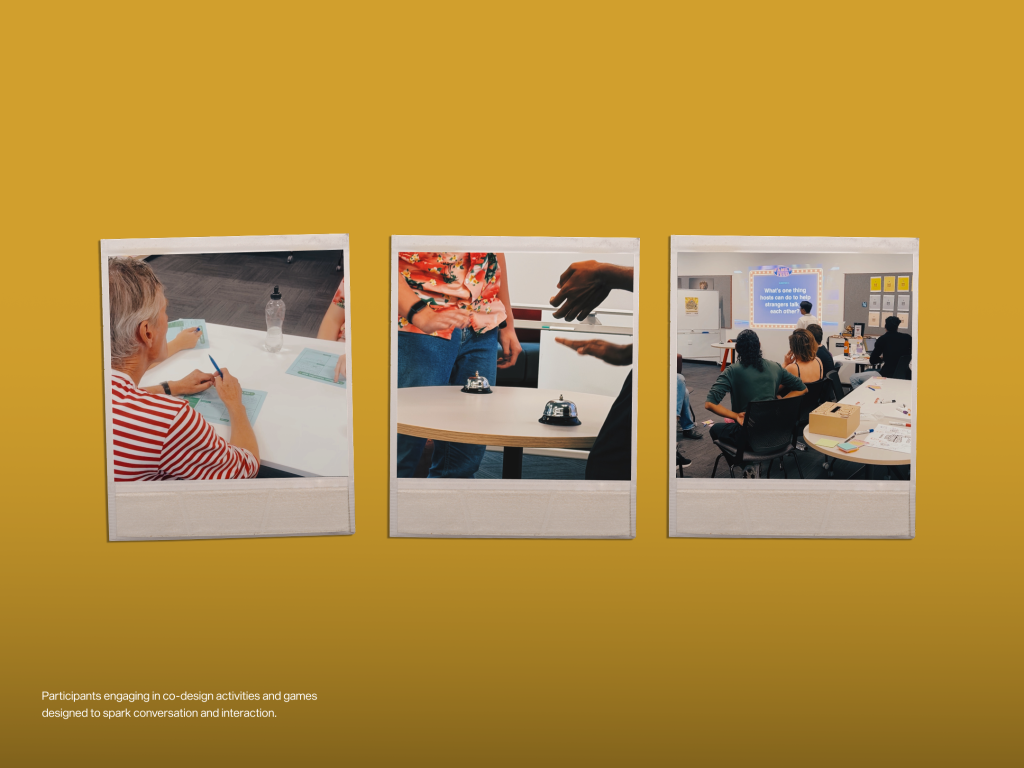
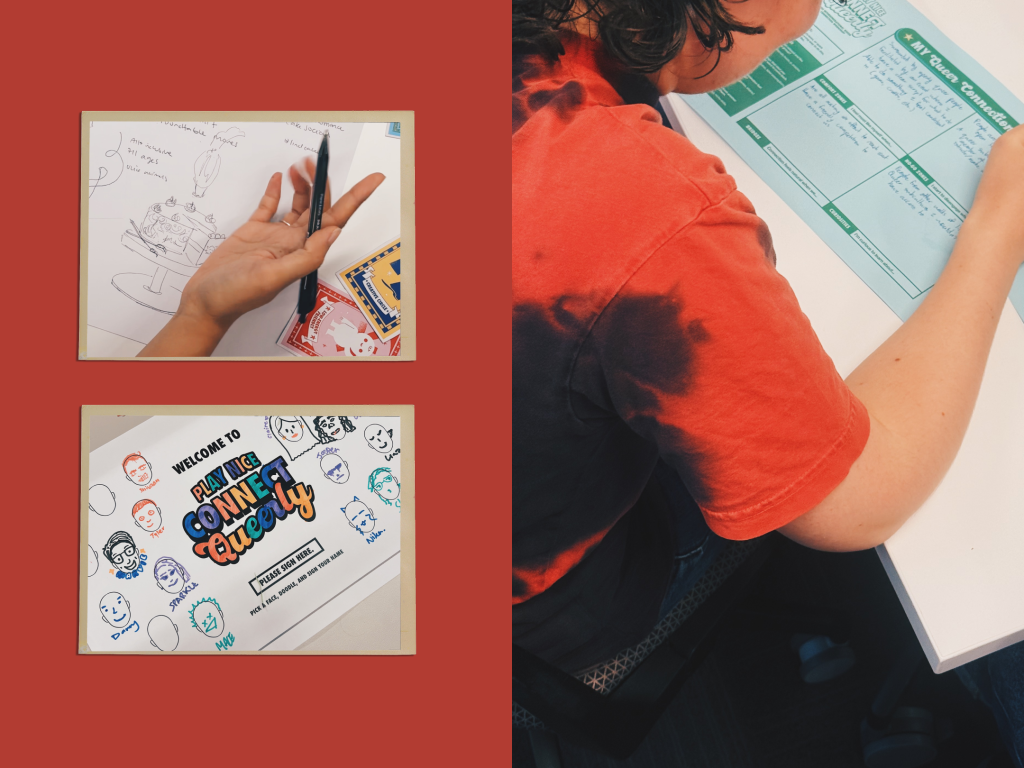
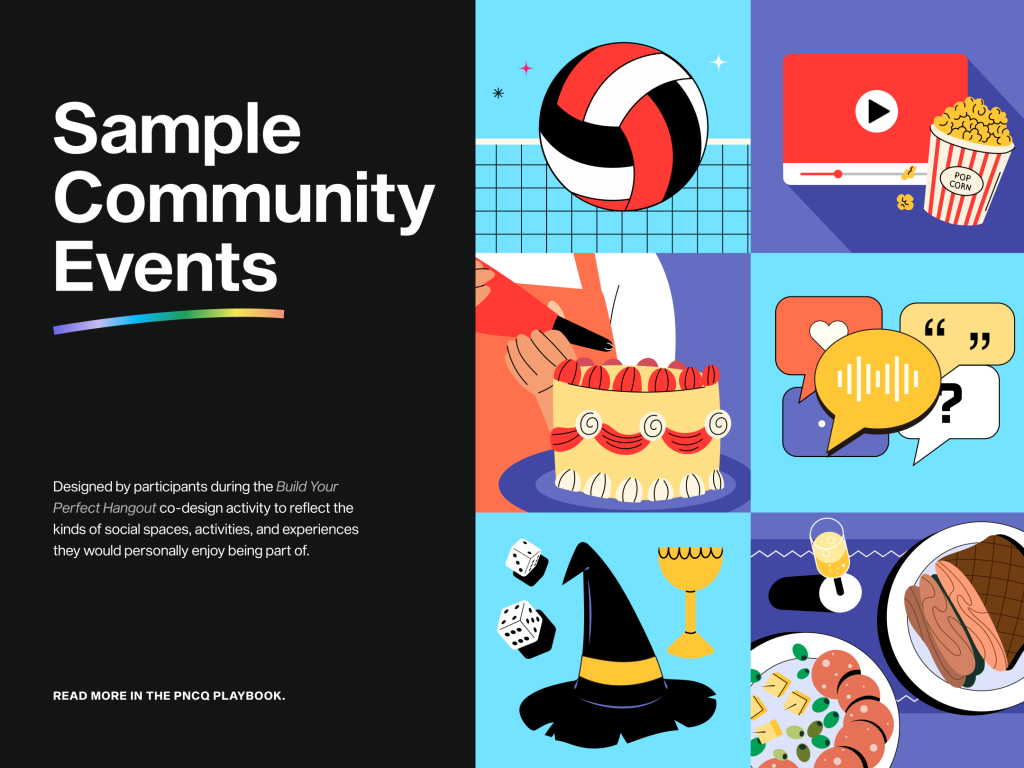
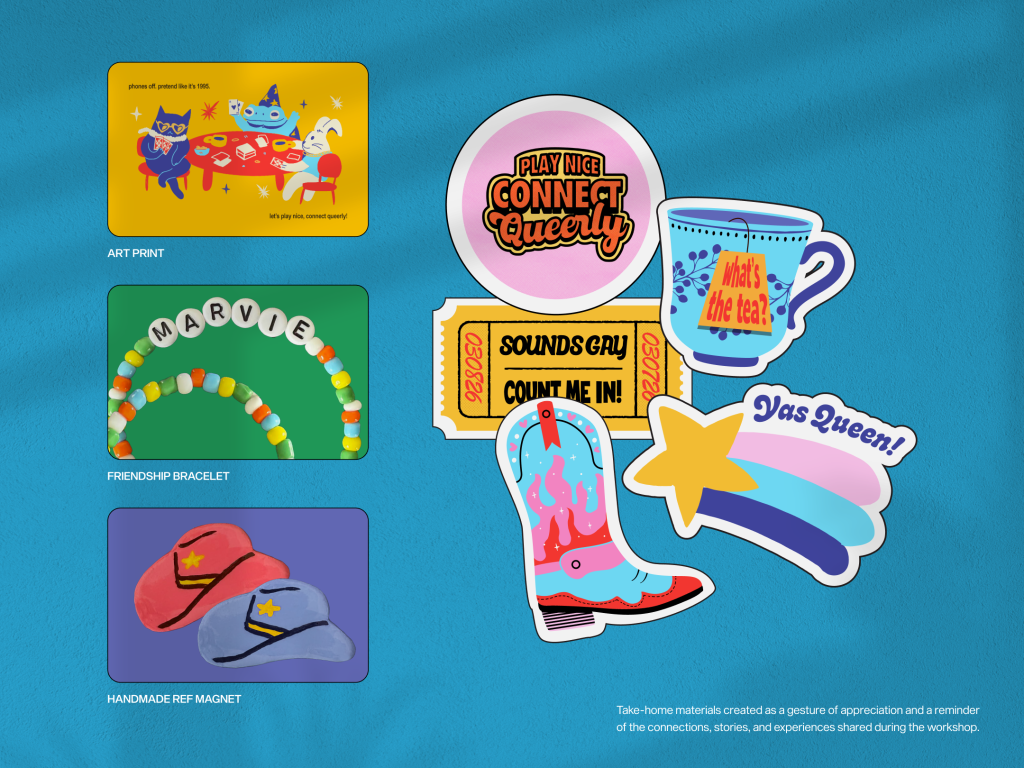
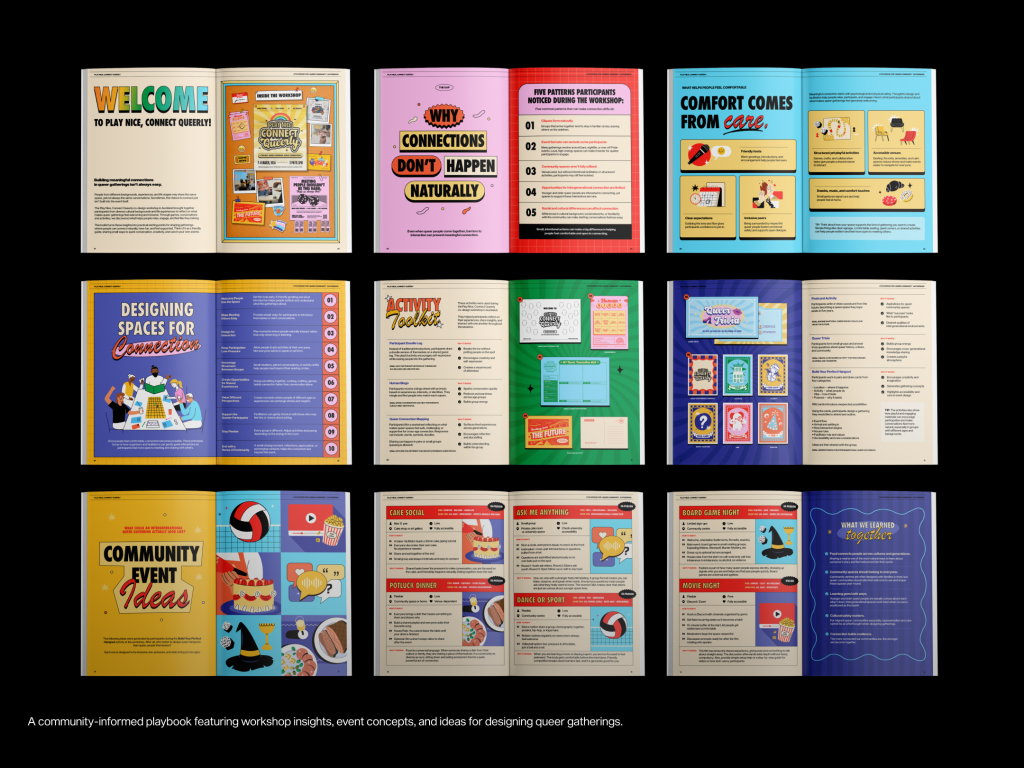
In response to the brief, I designed and facilitated Play Nice, Connect Queerly, a two-day co-design workshop that brought together queer people from different generations through games, creative activities, storytelling, and collaboration. Rather than designing for the community, I wanted to design with them. The project combined interviews, community consultation, co-design activities, facilitation, and visual communication to explore what helps build comfort and trust across generations, and to inform future community-led gatherings.
One of the biggest challenges was learning to step beyond my role as a commercial designer and become a facilitator, listener, and researcher. I also faced challenges recruiting older participants with limited time, budget, and resources, which highlighted the importance of trusted community networks and partnerships. One of the biggest breakthroughs came when I realised that creating a welcoming environment was just as important as the activities themselves. The success of the workshop wasn’t really measured by the exercises, but by the conversations and relationships that came out of them.
What were the catalysts/inspirations for undertaking post-grad and this particular project?
After working in the design industry for a decade, I wanted the opportunity to explore a topic that felt personally important to me. I had spent years helping other people bring their ideas to life, and postgraduate study felt like a chance to focus on something I genuinely cared about.
The project was also influenced by my own experiences of trying to meet people and build friendships as an adult. I realised how difficult it can be to connect with strangers, even in social settings designed for that purpose. That made me curious about how design could help make those interactions feel more natural and less intimidating.
I’ve always enjoyed organising games and activities for family and friends, so designing the workshop felt like a way to combine research, facilitation, and play in a way that was both challenging and genuinely enjoyable.
What insight can you give us into your design process?
One of the biggest shifts in my design process was learning to let the research guide the direction of the project rather than trying to control the outcome from the beginning. In my professional work, there is often pressure to move quickly towards a solution. With this project, I had to slow down, listen carefully, and stay open to where the research was leading me.
I also learned the importance of prototyping experiences, not just visual artefacts. Before running the workshop, I tested activities and refined them based on how people responded. My role was not to design solutions for participants, but to create the tools and conditions that would help them express their own needs, ideas, and experiences.
Through your post-grad research have you made any interesting or unexpected discoveries or insights that you can share with us?
One of the most unexpected discoveries from my research was realising that connection doesn’t just happen, it needs to be designed.
Through the workshop, I saw how small design decisions can shape the way people interact with one another. Structured activities helped reduce the pressure of meeting strangers, shared tasks encouraged conversation, and playful moments helped people feel more comfortable participating. I also learned that preparation and facilitation matter just as much as the activities themselves. When people feel welcomed and supported, they are more willing to engage with others.
Another insight was recognising that connection itself can be a form of care. Sometimes, simply creating opportunities for people to share stories and spend time together can be meaningful in its own right.
What has been the most challenging part of your research thus far? How did you overcome it, or are you still working to resolve it?
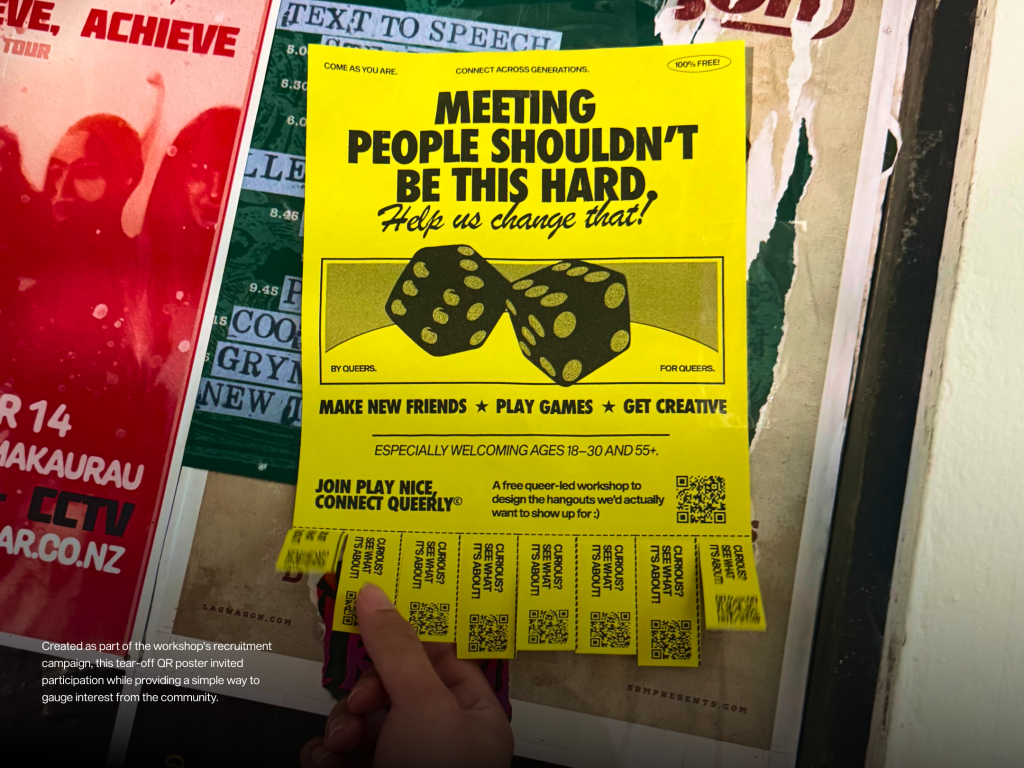
One of the most challenging parts of the project was recruitment, particularly reaching older members of the LGBTQIA+ community. I initially assumed that once I had designed the workshop and promotional materials, participation would naturally follow. Instead, I quickly realised that barriers such as timing, mobility, access, and trust played a much bigger role than I had anticipated.
The experience showed me that community engagement is not just about visibility. It is also about relationships and trust. Looking back, I would involve community organisations much earlier in the process, not only as channels for promotion but as genuine collaborators.
Another challenge was the physical production of the workshop. I underestimated the amount of time and effort required to prepare materials, organise logistics, and facilitate a two-day event. It taught me the importance of planning ahead, building realistic timelines, and asking for support when needed.
How has post-grad study impacted your design practice?
Postgraduate study has changed the way I think about design and my role within it. Before starting my Master’s, much of my work focused on creating brand identities, websites, user interfaces, and marketing materials. While those skills remain an important part of my practice, this project challenged me to step into entirely different roles.
For the first time, I found myself facilitating workshops, recruiting participants, and designing experiences that unfolded in real time. It pushed me beyond the screen and into situations where listening, adapting, and responding to people became just as important as the final outcome.
More than anything, I learned a lot about myself. For a long time, I saw myself primarily as a designer with strong technical and visual skills. This project helped me discover other strengths that I hadn’t fully recognised before. I found myself stepping into the roles of storyteller, facilitator, communicator, and connector.
I am leaving this course with a much deeper understanding of myself, the kind of designer I want to be, and the kind of work I want to continue doing. That understanding is something I hope to carry forward throughout my career as I continue to grow both as a designer and as a person.
Why did you choose this particular program/university/qualification?
What attracted me to Media Design School was the freedom to pursue self-directed projects around topics I genuinely cared about. I was excited by the opportunity to define my own research question and follow where it led.
I was also drawn to the programme’s practice-based approach. Rather than separating research from making, it encouraged students to learn through experimentation, testing, and reflection. That way of learning suited me because I tend to understand things best by doing them.
Another factor was the collaborative environment and the school’s strong connection to industry. I liked that the programme was grounded in real-world practice and created opportunities to engage with industry professionals, projects, and perspectives beyond the classroom. As someone coming from a professional design background, that balance between academic research and practical application was important to me.
The qualification appealed to me because it offered the chance to expand my practice in ways I hadn’t experienced before while building on the skills and experience I had already developed throughout my career.
Marvie Segismundo
Socials
Instagram
LinkedIn
Website
Email
Phone +642904317276
Media Design School at Strayer