From the Edges — Hā — Movement as Ritual Repair – By Linlin Chen
In our ‘From The Edges’ series we feature Aotearoa NZ Academic Design Projects. Our practice as designers can be seen to be explored, pushed and perhaps become something entirely new where it exists at the edges of our practice in the world of academia. Free from the constraints of commercial outcomes and clients, designers explore and challenge existing paradigms.
In this article, we talk with Linlin Chen about Hā, an interactive wellbeing project that reimagines movement as a gentle act of restoration rather than performance.
What’s your background?
I was born in Nantong, Jiangsu, spent my high school years in Singapore, and have been in Auckland since coming here for my Bachelor of Arts in Media and Screen Studies & Communication at the University of Auckland. I’m an introvert with a stubborn need to create — and my undergrad, while it taught me to read experiences carefully, gradually made me realise I wanted to be making them. The Master of Design is where that turn became real: it lets me bring storytelling and human experience together with research-through-design, and my work has gravitated towards interactive systems, embodied experiences, and immersive technologies. Looking back, the shift from media to design feels less like a change of direction and more like an expansion of the same interest — understanding how people experience, interpret, and connect with the world around them.
Alongside design, I edit videos, something I’d been doing long before studying design, and it shapes how I treat projects: not as products, but as experiences with a beginning, middle, and end. I’m also drawn to photography, film, and creative technologies where storytelling, design, and human experience meet.
Who is your favourite designer/creative/artist and why?
I don’t really have one favourite — my taste runs more as a texture than a monument. What I find myself returning to sits between two registers: cozy, healing worlds (Animal Crossing, Stardew Valley) and high-tech, speculative ones (Blade Runner, Cyberpunk 2077, The Witcher, classic sci-fi like Gattaca and The Thirteenth Floor). The visual cultures I love — dreamcore, Y2K, Frutiger Aero, cyberpunk — share that same tension: nostalgic and futuristic at once, all asking what technology feels like emotionally. Hā lives in the same tension — a project that wants to be quieter than technology usually allows it to be, while still using it.
What goals and aspirations do you have for the future?
In the immediate term, my goal is to take Hā beyond the master’s capstone — to test the system with real users from the populations it is designed for (anxious or culturally underrepresented users, older adults with limited mobility), to extend the cultural-artwork layer through co-design with Māori artists and other communities, and to complete the desktop and VR tiers that the current mobile baseline points toward.
Looking further, I’m hoping to move into doctoral research. The questions Hā has started to surface — about positionality, accessibility, and how cultural art can be the interface of wellbeing technology rather than its decoration — feel like they want a longer engagement than a one-year capstone can give them. I’m drawn to contributing to HCI research that takes the body, culture, and emotional experience seriously, particularly for users that current digital health systems still tend to make invisible.
More broadly, I want to keep making work that takes a stance — work that argues for something about how people deserve to be treated by technology, rather than work that merely functions well. The thing that has stayed at the centre of why I make — editing, designing, writing — is the wish to create something that produces emotional resonance in another person. That is what I want to keep at the centre of whatever design I do next.
When did you first learn about your area of specialty? What about it piqued your interest?
I came into interaction design through games — playing them, especially AR and VR ones. Beat Saber and Les Mills Body Combat first showed me how strange and beautiful it is when a screen knows your body, and how much more a system can be than its interface. That sense of immersion, of technology that feels close rather than transactional, is what pulled me toward the field.
Sci-fi shaped the same instinct. I love films like Blade Runner, Gattaca, The Thirteenth Floor, and Cyberpunk 2077 — and what they share isn’t the technology itself but a question: how do humans live alongside it? I think that is exactly what design is for. As AI lowers the technical threshold and powerful tools become accessible to almost anyone, the harder question is no longer how to build but how to choose and how to use — understanding both the technology and the humans it serves.
What complicates the picture is that the cutting edge itself still costs money: VR headsets, powerful computers, fluid smartphones. A human-centred designer cannot only design for the people embracing the new tools; we also have to design for the people who can’t yet. Hā, with its mobile-first baseline, is my attempt to take that double responsibility seriously.
What’s the background of your current project?
Hā is my response to the Master of Design Capstone brief, which asked us to design for inclusive and intergenerational wellbeing in Aotearoa, looking at our cluster’s work through the three lenses of place, systems, and emerging technologies. My answer was to build a movement-and-wellbeing system for the people that mainstream fitness technology tends to render invisible — anxious users, women who avoid being watched in fitness spaces, older adults with limited mobility, people whose cultural backgrounds aren’t reflected in the apps available to them.
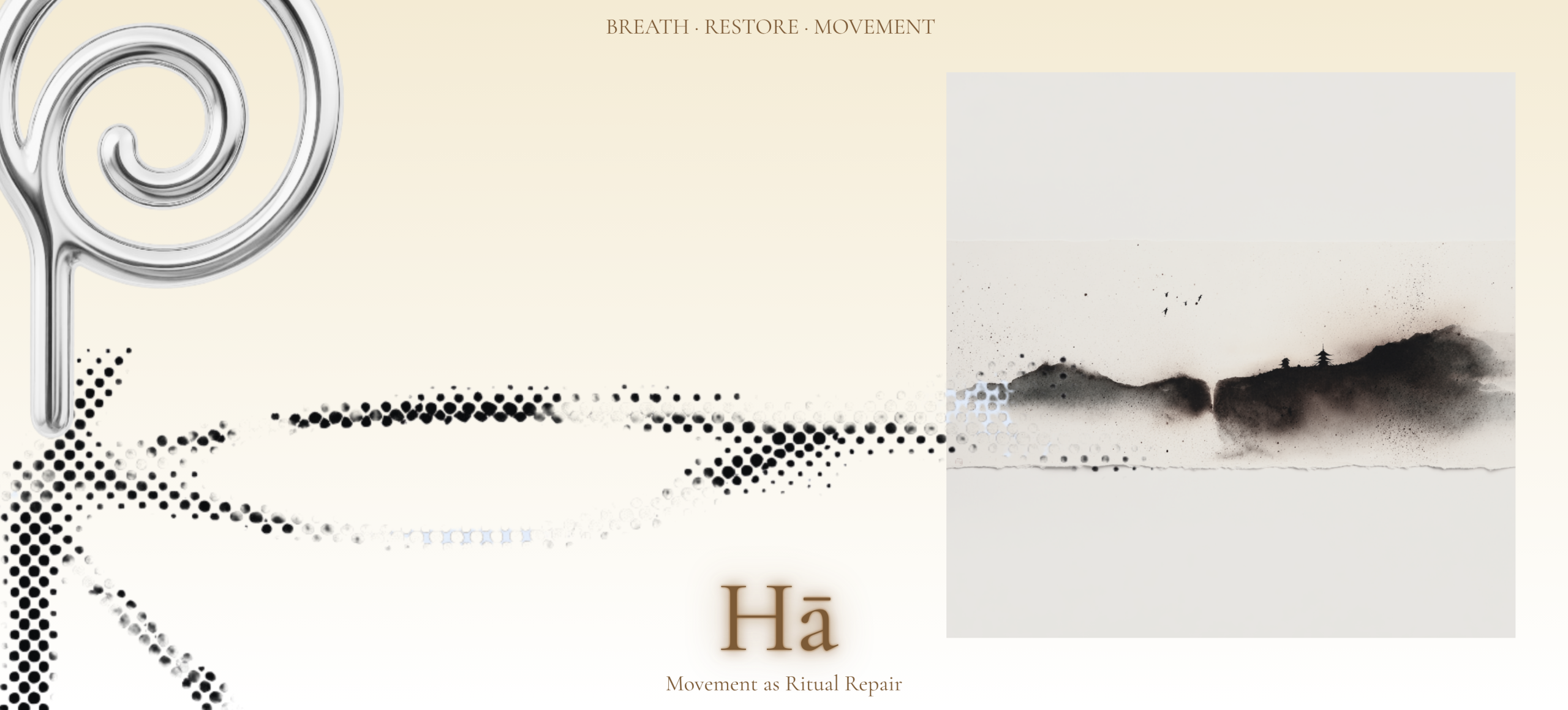
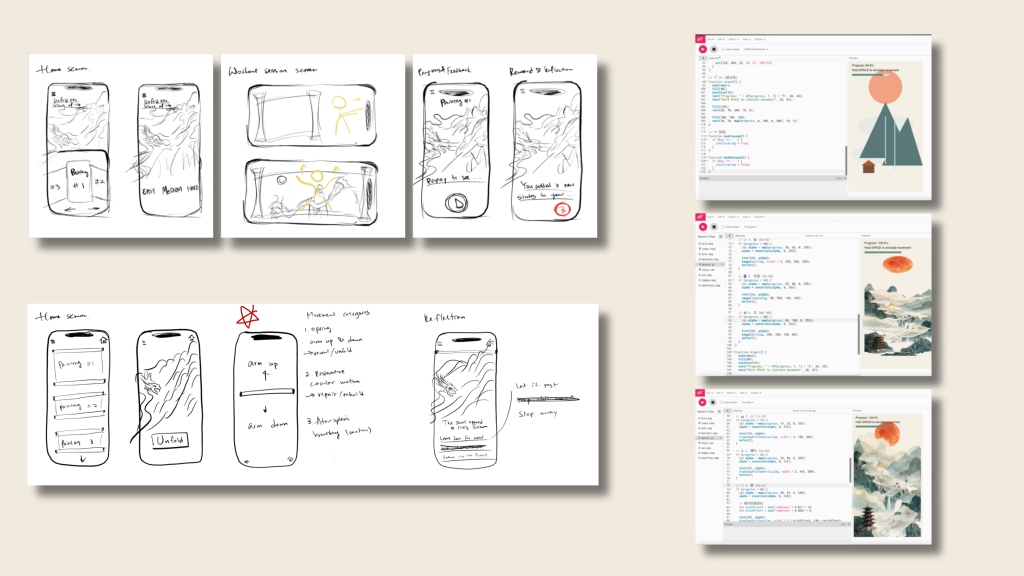
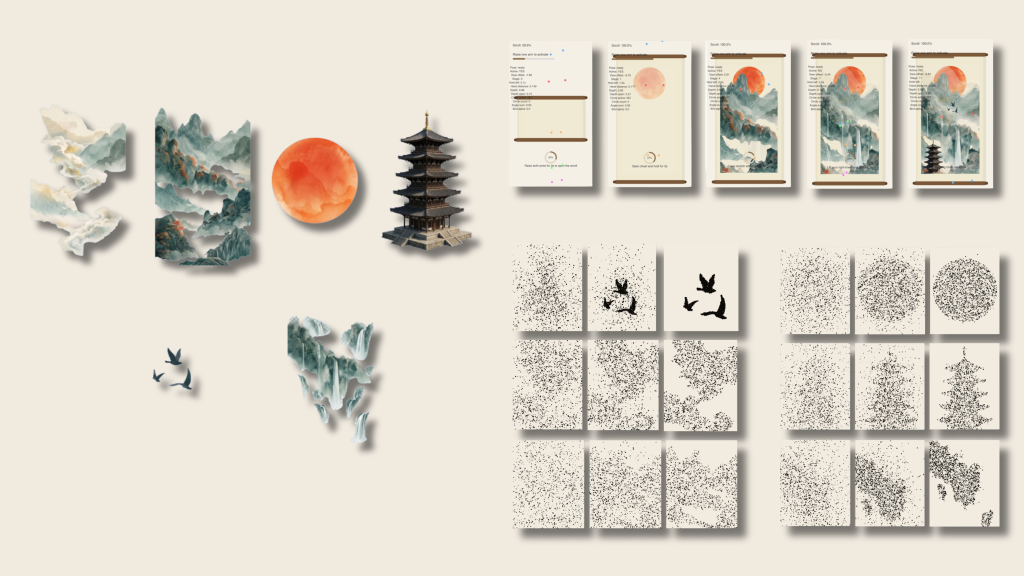
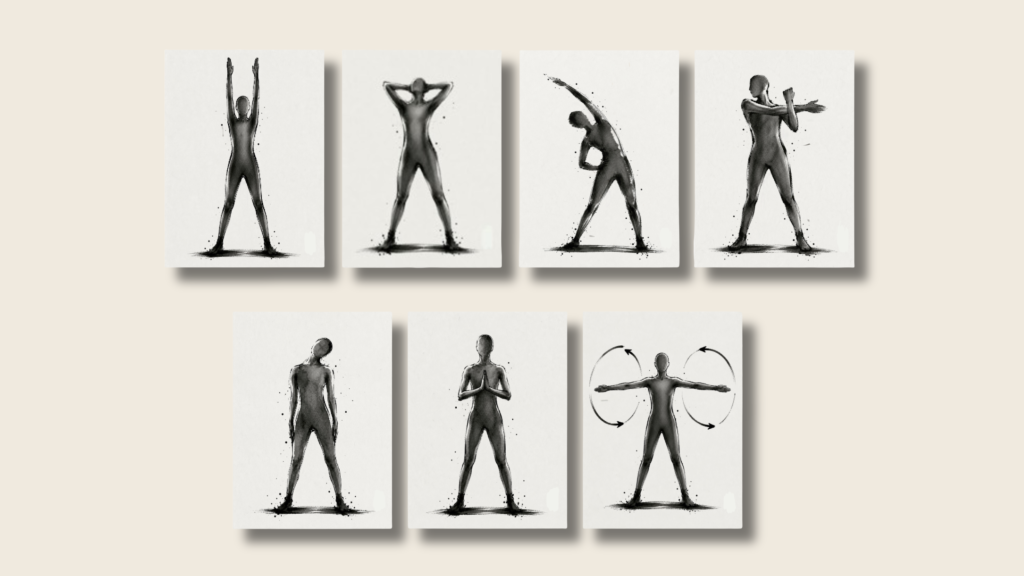
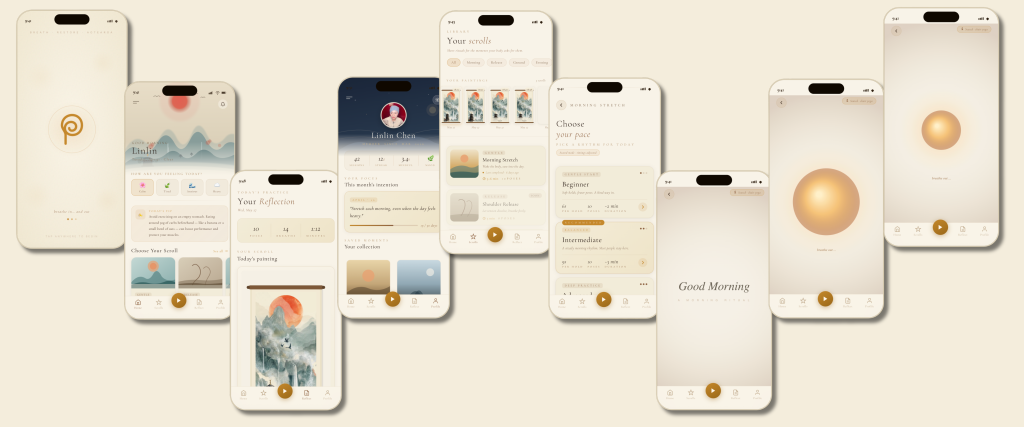
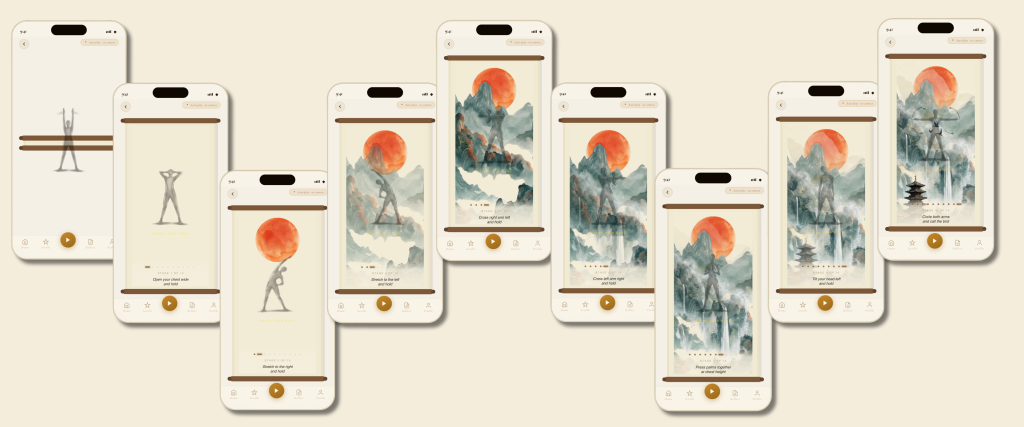
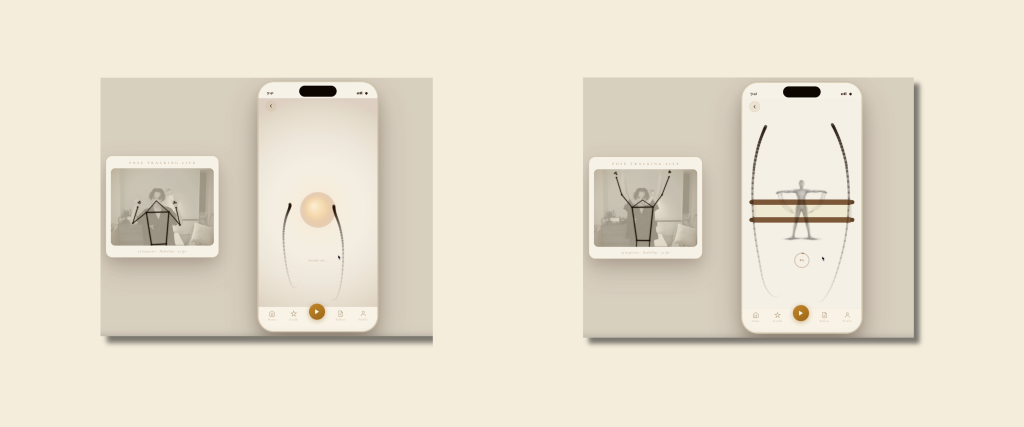
The system itself, Hā — te reo Māori for breath — uses a phone camera and pose detection to turn upper-body movements into the unfolding of a culturally specific scroll painting. Each held pose paints another element of the scene; over an eleven-stage sequence the user composes a landscape through their own body. Restoration replaces score. Story replaces streak. The system records nothing of the user during the session, shows them only an abstract ink-trail of their motion rather than a webcam mirror, and uses te reo Māori naming and a koru mark to anchor the work in Aotearoa through language and form rather than through borrowed Māori imagery.
What’s been interesting about building this is how often a constraint became a stance. The original concept was AR-based, but consumer phones can’t run both cameras simultaneously — so the project pivoted to mobile camera + motion capture, and the limitation became a commitment to reaching the people who use the device they already own. The motion-capture pipeline can only stably track the upper body — so seated, upper-body movement became the inclusive baseline and the home of a dedicated chair-yoga mode, instead of an afterthought.
The struggles were almost all in the iteration loop. The middle pose went through six attempts (knee lift → forward bend → wide side bend → T-pose → arms forward → finally chest-height prayer pose) before settling on something real bodies could reliably do. The particle aggregation that makes each scene element come into being through movement took four rounds of debugging. An attempted TouchDesigner audio bridge got the data pipeline working end-to-end but never reached full audio runtime; I document it as a future-work commitment rather than smooth it over.
The most interesting thing, looking back, is that none of Hā’s commitments are surface choices. They are technical decisions and methodological discipline, made visible. Tolerance, privacy, accessibility, cultural humility — each lives in code, parameters, named decisions, or an honest acknowledgement of the part that didn’t finish.
What were the catalysts/inspirations for undertaking post-grad and this particular project?
The catalyst for studying design was, oddly, the very thing I was already doing. As a Media and Screen Studies undergrad I wrote analyses of films and the work I admired, but along the way I realised that analysis wasn’t enough for me — I wanted to make the kinds of work I was learning to read. Filmmaking is collaborative and slow, so I started editing instead: re-cutting scenes from films I loved against music I loved, watching how a careful edit could make a stranger online write I felt that. That feedback was the first time I understood that my aesthetic could become a thing other people had feelings about. When I began adding graphic-design elements to those edits, the shift was already underway. Then I watched the UoA Master of Design admissions video and saw students who had come from nursing, pharmacology, every adjacent field — and I realised design might be the rare discipline that takes seriously what people from different backgrounds bring with them. I came in expecting it would be about posters, UI, products. I’m leaving with a much wider sense of what design is allowed to discuss: emotion, body culture, the future, inclusivity, women’s experience, wellbeing.
Hā itself started somewhere more conventional — I wanted to make an immersive home-fitness app, partly because I already use XR fitness apps alone at home. I’m introverted, I don’t have a car, my apartment’s gym is small, and even when I do go to one I feel the gaze. The longer I sat with that, the clearer it became that what was making it hard for me to move wasn’t laziness — it was shame, the social eye, time pressure, the feeling of not being ready to be seen. As a woman, I know these aren’t only my barriers. Meanwhile most fitness systems were still telling me More. Faster. Better. Stronger. Almost none of them were saying it’s okay to move gently. It’s okay to move for yourself. That line is where the project tilted — from fitness toward something closer to emotional restoration. I wanted movement to be a form of care.
What insight can you give us into your design process?
I work as a designer who learns by making — what HCI calls research through design. Rather than gathering evidence first and applying it afterward, I treat the prototype as the thing through which the research actually happens. Each iteration produces both a system that does something and an argument about why it does it that way. Hā in particular has gone through many cycles where what looked like a craft choice — a softer breath cadence, a wrist-trail shape, a default mode — turned out to be a stance about who the design wants to make feel welcome.
Two things have shaped my process most. The first is taking positionality seriously. I share lived experience with some of my users (international students who feel watched in fitness spaces, women navigating gendered exclusion), I have observed others firsthand (rural NZ communities I’ve spent time in), and for still others I am clearly an outsider (older adults with limited mobility — where I draw on close observation of older relatives — and Māori wāhine, where I am an outsider-designer in the strict sense). Naming the asymmetry is part of the work, not a footnote to it. Different layers of relationship call for different methodological commitments — some adopted, some respectfully deferred.
The second is being honest about what is a finding and what is a hypothesis. Because ethics approval for end-user testing sat outside this phase, I substituted projective persona scenarios — comparing each user’s as-is state with a projected to-be — and held them explicitly as design hypotheses for subsequent research to confirm, revise, or contradict. The discipline I try to keep across the whole project is: claim nothing the work has not earned, and name the parts that haven’t been earned yet.
Through your post-grad research have you made any interesting or unexpected discoveries or insights that you can share with us?
A few discoveries surprised me. The first was how often a technical constraint turned into a methodological stance. Most consumer phones can’t run both cameras at once, so AR became unfeasible — but the pivot to mobile-camera + motion-capture became a commitment to inclusion rather than a compromise. Pose detection can only stably read the upper body — so seated, upper-body movement became the inclusive baseline rather than a fallback. By the end of the project I had stopped reading my technical limitations as obstacles and started reading them as commitments waiting to be articulated.
The second was a piece of literature I expected to support my project that actually challenged it. The largest randomised controlled trial of chair-based yoga (Tew et al., 2024) found no significant improvement in mental health or quality of life, while confirming that the programme was safe, deliverable online, and cost-effective. Initially this felt like a problem. Then I realised the gap between “safe and acceptable” and “actually beneficial” was almost certainly an engagement gap — and that engagement gap is exactly what aesthetic, culturally resonant design might be able to address. A null result reframed as a design opportunity is, I think, one of the strongest things I’ve learned to do this year.
The third was simpler and quieter: body tracking is not button input. After six attempts to design a stable middle-section pose, what I came to see was that the right detection threshold isn’t exact — it’s enough. The system should be tolerant of bodies that don’t perform “right,” because the body that can’t perform an exact gesture is exactly the body the system is for.
What has been the most challenging part of your research thus far? How did you overcome it, or are you still working to resolve it?
The hardest moment in the project so far was the AR pivot. I had built the early concept on a vision of augmented reality in the user’s room — front camera tracking the body, back camera overlaying the scroll painting onto the actual space. The longer I worked with the idea, the more clearly I saw that consumer phones overwhelmingly cannot run both cameras at once. My technical advisor confirmed it. The choice came down to: keep the most impressive version of the project and quietly exclude most of the users it was meant for, or let go of AR. I let go of AR. Reading Mandic et al.’s (2023) work on pose tracking from a single mobile camera was what made the pivot possible — it preserved the most valuable capability the AR direction offered (shame-free, spatial feedback) while shedding the hardware that excluded my users. It still took a few weeks to stop mourning the version I had abandoned. But that pivot is now what the rest of the project’s commitments are built on.
The unresolved challenge is the Māori cultural-art layer I want the system to eventually host. I do not have the right to bring Māori artistic forms into the artwork layer without co-design with mana whenua and engagement with mātauranga Māori, and that work is not something a one-year master’s capstone can responsibly attempt on its own. I name it openly in the report as a future-methods commitment, not as a delivered feature — but it remains the part of the project I am most aware of not yet having done.
How has post-grad study impacted your design practice?
Post-grad study has changed what I think design is, not just what I think it does. I came in with a fairly conventional sense of the discipline — posters, UI, products — and I am leaving with a much wider understanding of what design is allowed to discuss: emotion, body culture, the future, inclusivity, women’s experience, wellbeing. That widening has changed the way I work.
Practically, the biggest shift is that I now treat making as a way of producing knowledge, not just a way of delivering it. Research through design has become my methodological home — prototypes are where the actual research happens, and each iteration is both a system and an argument about why the system is the way it is. The other shift is around honesty. I have learned to distinguish between findings and hypotheses, to name what I have and have not earned, and to take positionality seriously — to be precise about whose lived experience I share, whose I have only observed, and where I am clearly an outsider-designer.
The deepest impact, though, is more quiet. Post-grad has made me see that the best moments of a design project often come from being honest about a limit. The constraints that look like obstacles — a technical pivot, a population I cannot represent, a feature that didn’t fully run — turn out, more often than not, to be the places where the project’s commitments become legible. I am leaving the master’s with a much firmer sense that design is an ethical practice as much as a craft one.
Why did you choose this particular program/university/qualification?
I chose the Master of Design at the University of Auckland for a few reasons that aligned at once. The most immediate was that I was already in Auckland — I’d completed my undergrad in Media and Screen Studies & Communication at UoA, and staying meant I could carry that grounding forward rather than starting from scratch elsewhere. The deeper reason was the kind of design education the program seemed to offer. When I watched the admissions video and saw students who had come from nursing, pharmacology, and every adjacent field, I realised this was a program that did not require a “traditional” design background — it actively wanted what people from different fields brought with them. That mattered to me. As someone coming from media analysis rather than from a craft-based undergraduate, I needed a program that would treat my prior training as material, not as a deficit.
What I have found in the program is even closer to what I was looking for than I expected. The Master of Design is organised around social themes — wellbeing, inclusive places, financial systems — and asks students to address them through real research-through-design work. That framing made room for me to design for people, with all their cultural, emotional, and bodily complexity, rather than to design objects in isolation. It is the framing in which a project like Hā could exist; I’m not sure it could have happened in a more conventional design program.
Socials
Website
LinkedIn
Instagram
Video editing channel
Acknowledgments
Aaron Fry (Supervisor, University of Auckland), Aldo (Technical Advisor, University of Auckland), and Yilin Ke (Doctoral Researcher whose work on invisible users in digital health informed the theoretical framing).