5 minutes with Carol Green
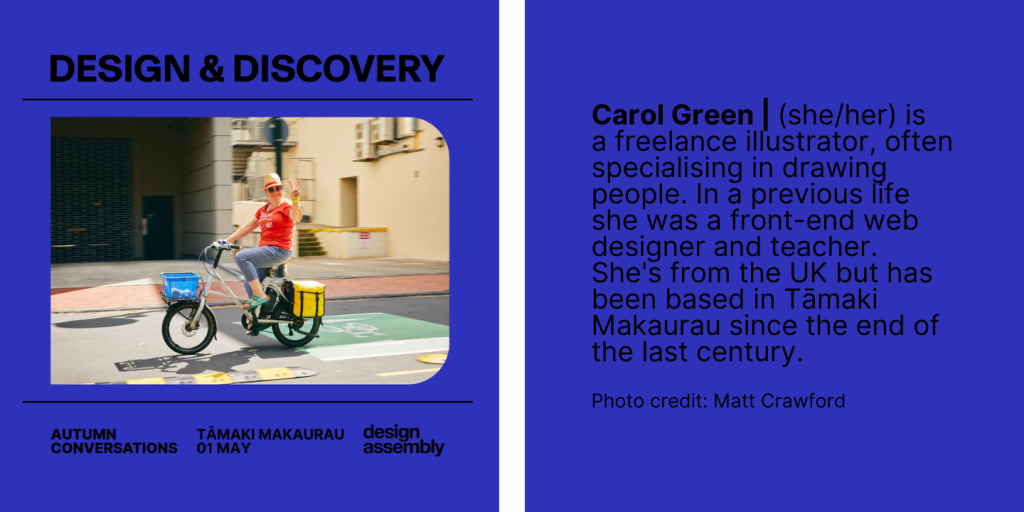
Ahead of Autumn Conversations: Design & Discovery in Tāmaki Makaurau on 1 May, we sat down with one of our featured speakers, Carol Green. Register for your ticket to attend the event here.
This season we’re discussing what happens when you have the freedom to play, make and discover without client or commercial boundaries. Our speakers will share the stories behind their side projects, hobbies or community involvement that have led them to transformative discoveries.
Join us at the 2025 Design Assembly Autumn Conversations events taking place across Auckland, Wellington, and Christchurch.
Kia ora Carol. Can you share a bit about your background and your day job?
Kia ora Design Assembly! I’m a self-employed illustrator.
I grew up drawing all the time. I drew at school and out of school and my Mum still has a folder of some of my kid-drawings in the mistaken hope they’ll one day be important.
I did a fine art degree in the UK, specialising in performance. I used a lot of video and other technology-of-the-time in my work and ended up learning how to make websites in the very early days. From there I started making websites and teaching other people how to make websites and other multimedia projects (Flash! And Director! Let’s see how old you all are).
I made websites for about 20 years. Then one day in 2017 I realised I didn’t enjoy it any more. Most of the creative part was being done better by 3rd-party solutions than by me.
So I did a gradual side-shuffle into illustration, casting off web clients one by one, over a few years, and persuading clients, friends-of-clients and friends-of-friends that I could draw things for them.
By that point I’d done 3 ½ rounds of Emma Rogan’s 100 Days Project (one creative thing a day for 100 days). Each time I had done something illustration-based. Giving myself restrictions was good; one year I drew only with two sizes of Sharpie. Another year I drew someone/something on a bicycle each day on one page of a paper-sample book. The 100 Days Project was formative for my drawing practice and my confidence. When I signed up I really wasn’t convinced I had the stamina to do something for that long. But as I passed the fortnight mark where lots of people dropped off, the impetus to complete the project kicked in.
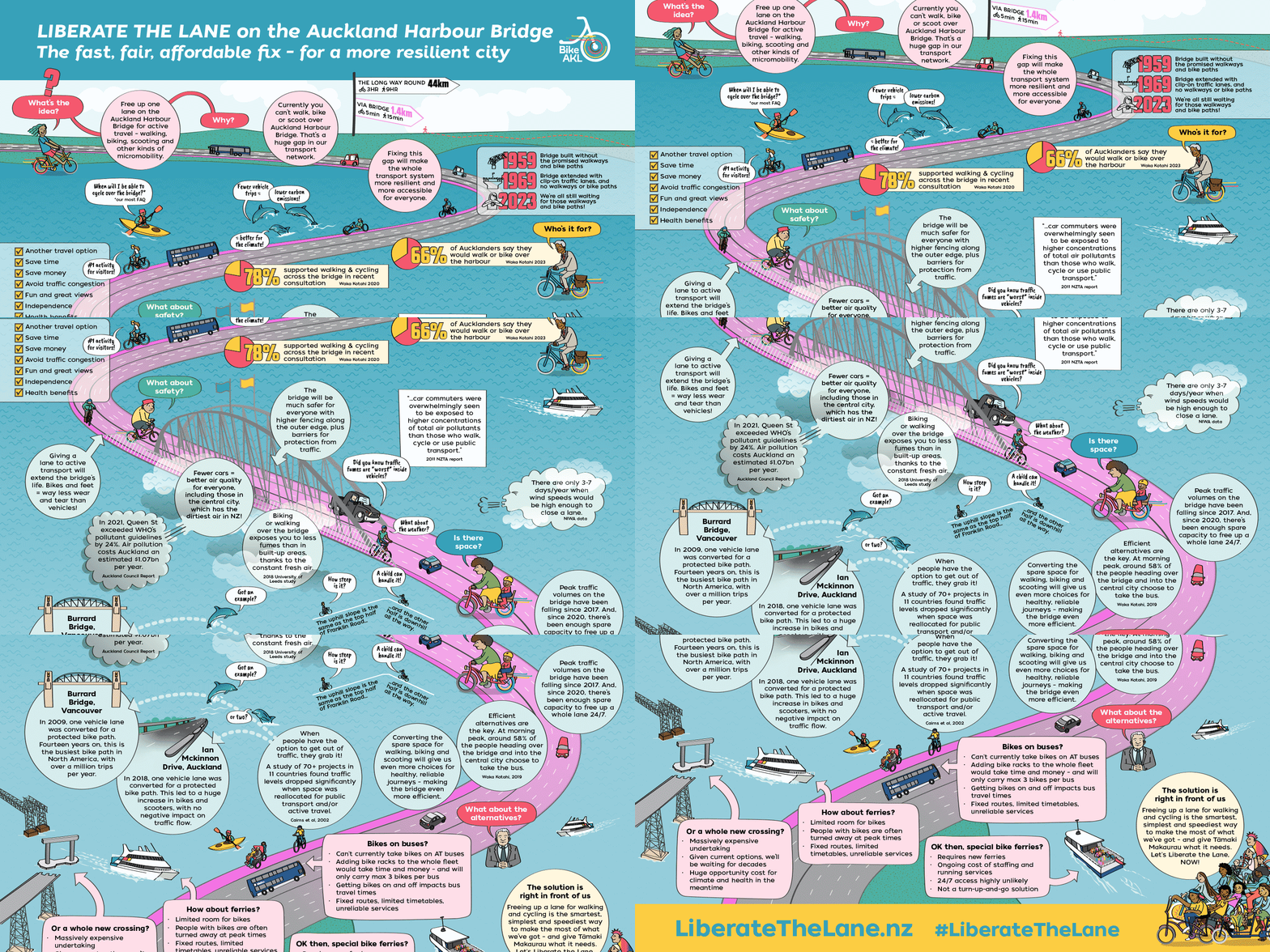
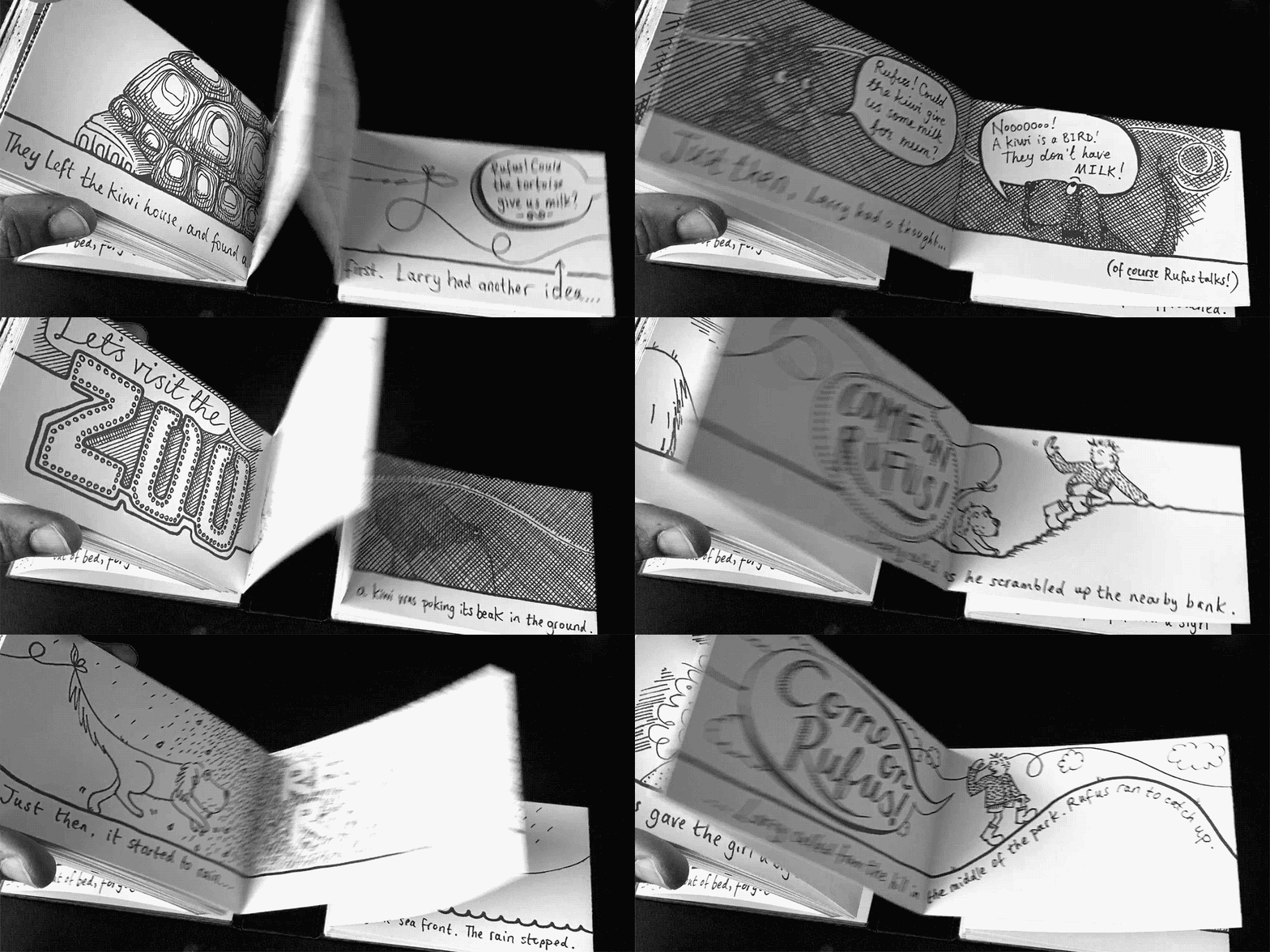
Since then I’ve worked on a pretty varied range of projects; from a 20-page comic about how kids felt about the first Covid-19 lockdown; through pictures to help young people in the youth justice system understand what’s happening around them and an infographic about why people should be able to cross Auckland Harbour Bridge on a bicycle; to a book about a lost dog. Most of my work involves drawing people.
What role does curiosity play in your creative process, and how do you cultivate it when there are no external constraints?
I’ve done quite a bit of work with University academics, usually presenting an aspect of research, which requires at least a basic understanding of the subject. Sometimes that’s been in my field of interest already – like the active travel to school study I did with the School of Nursing, and sometimes it’s been a totally new-to-me subject, like Soilsafe’s study of heavy metals in the soil (and therefore in our food) from air pollutants.
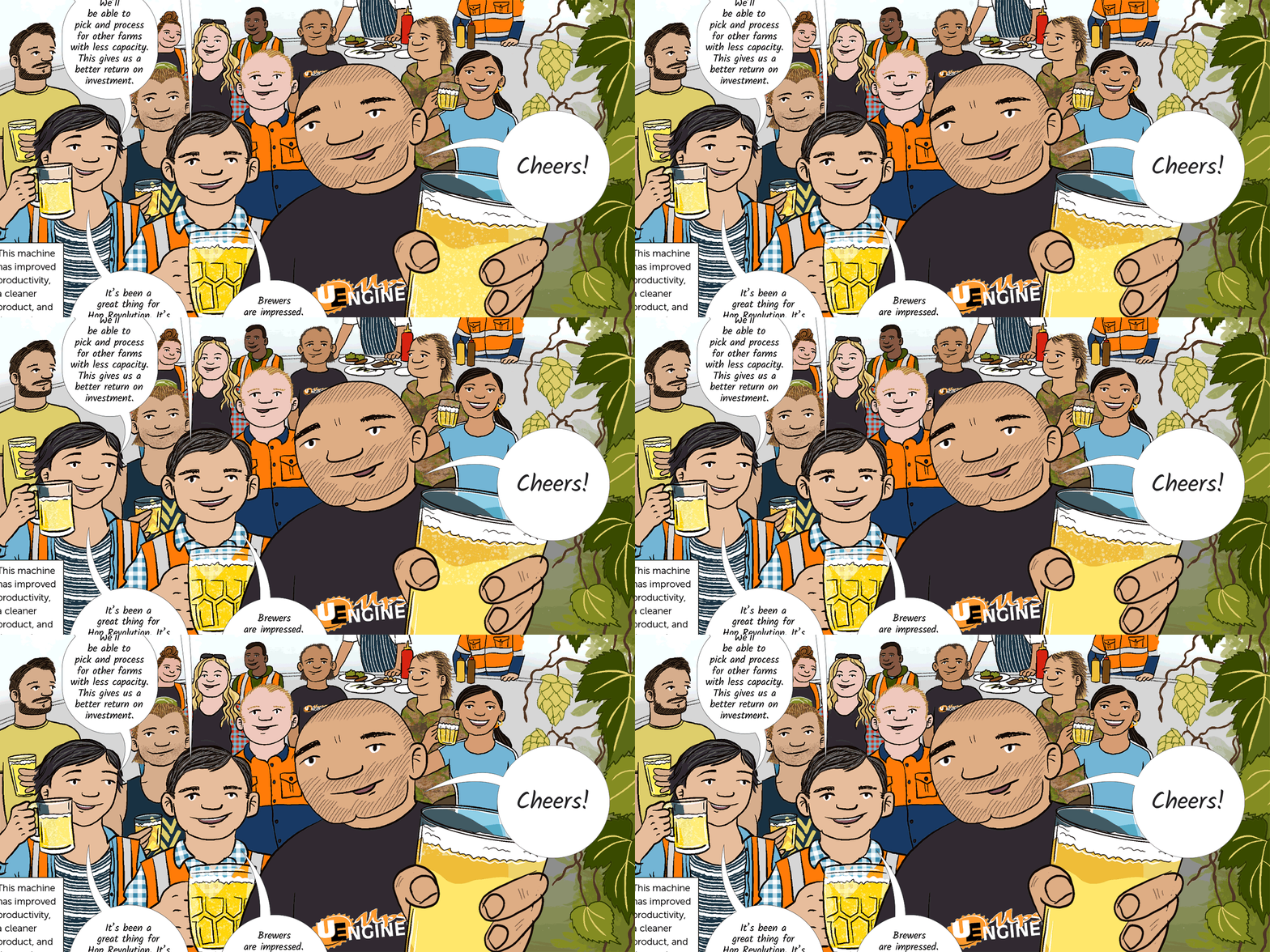
I love learning new things. 18 months ago I made multi-page comics about resurfacing Christchurch Airport runways and about some engineers who developed a new hop-picking machine, which at first glance, don’t seem like interesting subjects. They are; Ask Me Anything.
My internal monologue goes pretty much 24-7 and I think much of that is based on observing things. I ride a bicycle everywhere and I find that bicycling speed (or slower) is really useful for observation and subsequent processing of those observations.
If you could remove all limitations—time, budget, expectations—what would be the next thing you’d create purely for yourself or the world or a community?
I’d really like to write/draw a comic about my grandmother’s sister Freda, an early-days female doctor with a very tragic story. I need to start by carving the elephant into edible chunks, and I do need to get on with it since my mother is the only person left who knows some of Freda’s story.
Outside of commercial briefs and projects, what do you believe the purpose or role of design is and could be in the future?
I think design is really important in humanising numbers, concepts and data to the general public. Just think about what Toby Morris and Siouxsie Wiles’s work did for our understanding of virology during the initial phase of the pandemic. I often find myself yearning for clever graphics to explain some of the things happening in world events and politics. Political cartoonists fill some of that gap – they’re so clever and work so quickly, and they really need to be seen more widely.
Ahead of the Autumn Conversations Tāmaki Makaurau event coming up on 1 May, can you give us a teaser into the project/topic you’ll be presenting?
I’ll probably talk about my side-shuffle and how my work-life priorities influence what I do. No guarantees though – I’m a desperate last-minute-er so I haven’t worked out exactly what I’ll talk about yet.
Lastly, what’s the best way for folks to see more of your work and connect with you?
I try to keep my website up to date with work that can be publicly shared – carolgreen.net. I post a small amount of work on my Instagram (@carol.greenie) if you have the patience to wade through photos of craft projects, bicycles and food.
Register here for your ticket to Autumn Conversations: Design & Discovery in Tāmaki Makaurau